There was a great distance between Norway and Rome in the 12th century. But through the Catholic Church, Norway nevertheless maintained close ties to the pope in Rome.
In 1189, King Sverre and the Birkebeiners held power in Norway, following a long struggle against rivals supported by the Church. Priests and bishops took part in the conflict. Bishop Nikolas Arnesson led a group of rebels who set fire to houses and churches in Bergen.
Relations had been turbulent between two of Norway’s most powerful figures, the king and the archbishop. But a new archbishop was now in place in Nidaros. Eirik Ivarsson was determined to cooperate with the king. In 1190, he and King Sverre had a peace agreement ready for the country.
It was not long before relations broke down again.
Disagreement over power in the Church
The king wanted to be crowned by the bishop, but Archbishop Eirik refused to crown Sverre without the pope’s approval.
The two fundamentally disagreed about the relationship between the state and the Church.
Sverre believed that the Church should be subordinate to the king. Eirik believed that the Church should obey the pope and have considerable independence from secular rulers.
In Rome, Pope Clement III was in office. Eirik Ivarsson visited him in 1189. That year, the conflict between Eirik and Sverre was intense.
Archbishop Eirik Ivarsson received the pallium, a white collar symbolising his dignity and position as archbishop. But he also brought something else back with him to the north.
They must comfort, not fight
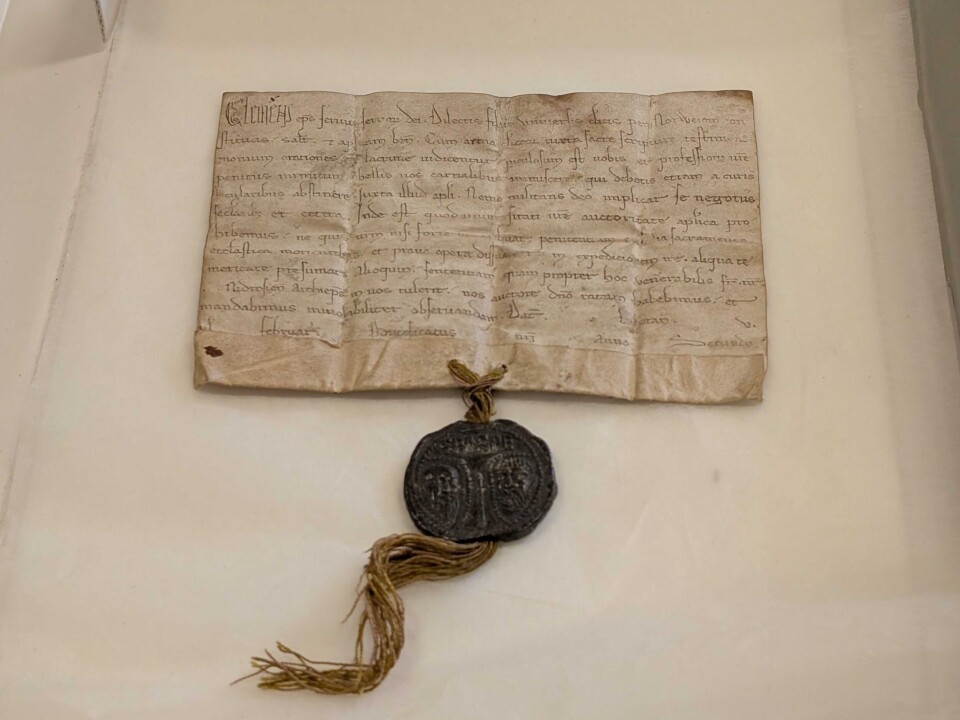
Eirik returned with what is today the oldest letter in Norwegian collections.
Annonse
The pope naturally sided with Eirik in his conflict with King Sverre. Nevertheless, he did not want priests to engage in warfare.
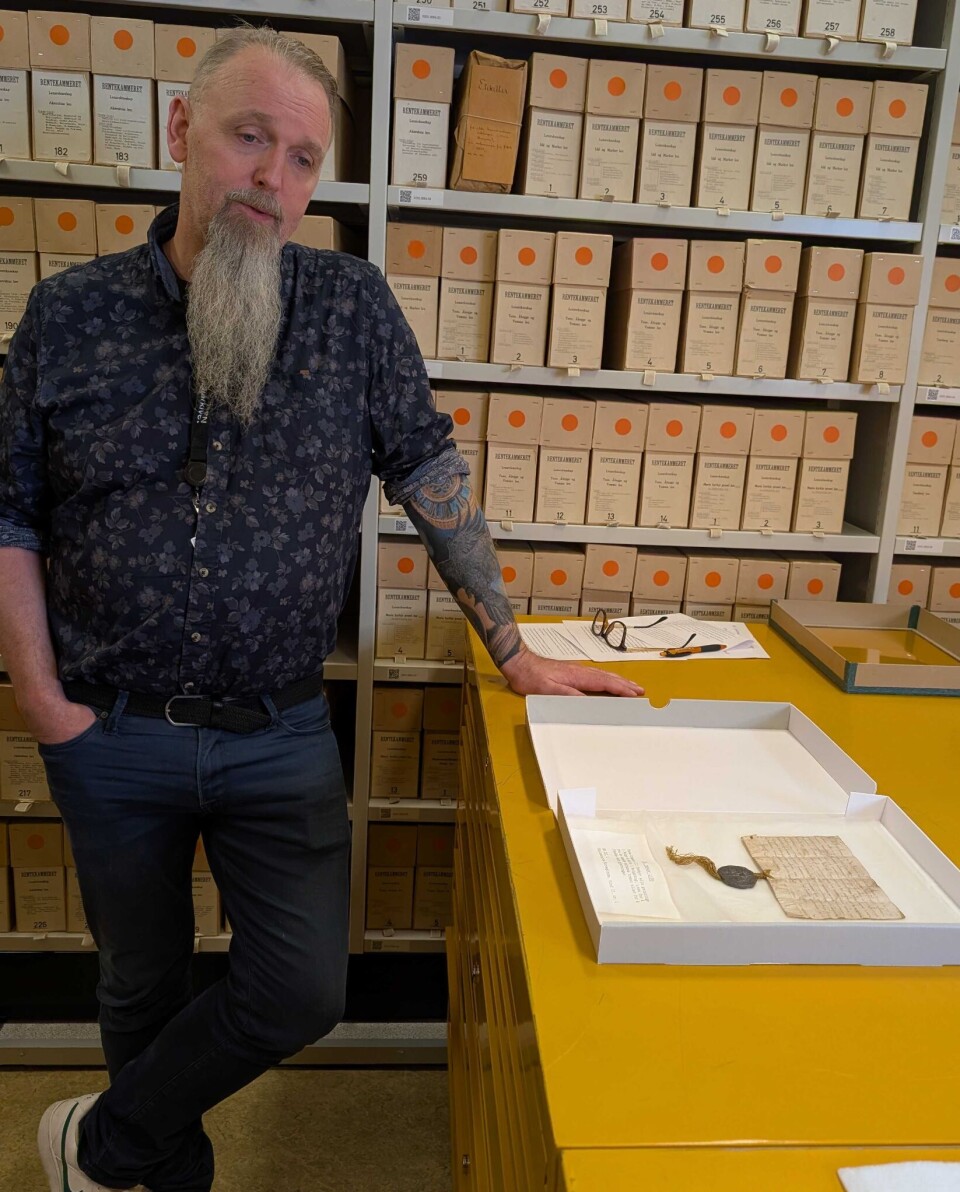
Jo Rune Ugulen Kristiansen with Norway's oldest letter.(Photo: Anders Moen Kaste / Science Norway)
In the letter, the pope issued a prohibition to the priests.
"Pope Clement III writes to all the clergy in Norway, telling them that they are not permitted to engage in warfare. Their role is to provide spiritual care and comfort the wounded and dying," says Jo Rune Ugulen Kristiansen.
He is a senior archivist at the National Archives of Norway.
After King Sverre eventually won the civil war, several bishops fled the country. Eirik sought refuge with a Danish archbishop in Scania, which at the time was part of Denmark.
Sverre was eventually excommunicated by the pope.
Eirik Ivarsson did not return until King Sverre died in 1202 and his son, Haakon III Sverresson, took over. Eirik and Haakon got along better.
What the papal letter from 1189 says
Clement, bishop, servant of the servants of God, sends greetings and apostolic blessings to his beloved sons, all the priests of Norway.
Since the weapons of priests, according to Holy Scripture, are prayers and tears, it is dangerous for you, and contrary to your calling, to take part in secular wars. You must keep yourselves away from worldly disturbances, in accordance with the words of the apostle: “No soldier entangles himself in worldly affairs,” and so forth. For this reason, by apostolic authority, we forbid all of you from being so thoughtless and careless as to participate in military campaigns, except for the purposes of administering penance and other ecclesiastical sacraments to dying men, and discouraging evil deeds. Otherwise, with God's support, we shall approve and require strict observance of whatever judgement our brother and father, the Archbishop of Nidaros, passes upon you on account of this.
Given at the Lateran [the pope's residence] on 28 Januar,y in the second year of our pontificate.
The letter has remained in good condition after 850 years of being stored in various locations. The National Archives of Norway received the letter in 1937 from the Arnamagnæan Collection in Copenhagen. It had originally been kept in an archive in Trondheim. It was from here that the historian Árni Magnússon borrowed the letter, along with many other medieval documents.
“This is the oldest letter in our collection. Indeed, it's the oldest original letter in Norway,” says Kristiansen.
The letter is believed to have been written on donkey skin. The papal seal is made of lead, with yellow hemp cords.
“Hemp was used for seal cords when letters contained commands or prohibitions,” says Kristiansen.
A wide gap between ideals and reality
“Popes usually wrote letters because a complaint had reached them,” according to Anders Winroth.
He is a professor of history at the University of Oslo.
“I assume someone had complained that priests were using weapons in the conflict taking place at the time,” he says.
The complaint to the pope could also have come from someone on Sverre’s side, according to Winroth.
He explains that priests were often involved in what was happening in the society around them. They had clear ideals they were expected to live up to. For example, they were not supposed to be married.
In reality, however, they often were, according to Winroth.
Nor were they supposed to use violence. But reality could be different.
“There was often a wide gap between ideals and reality in the medieval Church and society,” the historian says.
They could defend themselves with violence
The papal letter from 1189 does not include all the nuances, Winroth explains. The Church did indeed forbid priests from using violence. But there were exceptions.
"The Church permitted violence in self-defence if they were attacked," he says.
There could be a considerable gap between ideals and actual behaviour among medieval priests, says Professor Anders Winroth.(Photo: University of Oslo)
For example, they might encounter robbers while travelling. If they were travelling through a dangerous area, they were permitted to carry weapons.
"But none of this is mentioned in the letter from 1189," says Winroth.
What impact did the letter have?
We know the letter reached its destination
"It's difficult to imagine that this particular letter had any significant immediate effect," says Winroth. "Nevertheless, we know that it reached its destination."
Over the centuries that followed, it became increasingly uncommon for Catholic priests to participate in warfare. This was also true in Norway, Winroth notes.
Although violence was prohibited, many priests sought exemptions so that they could take part in war. But they were only granted permission if they could convince the pope that the violence was carried out in self-defence, according to Winroth.
"Since a priest would be removed from his position if he used violence for anything other than self-defence, I believe priests became increasingly cautious about using violence," the historian says.