You can now explore Nordic medieval treasures yourself
Letters and books from the Middle Ages are being made available to everyone on a new Nordic website.
Agreement concerning the exchange of properties. To ensure that the agreement was valid, it was split in two, through the middle of a word. The two parts could then be put back together again if anyone questioned the agreement.(Photo: Anders Moen Kaste / Science Norway)
Even at the end of the 17th century, many people were interested in the Middle Ages.
Collectors and historians travelled around looking for old letters and documents scattered throughout Norway, Iceland, and Denmark.
One of these historians was Árni Magnússon. He collected books, letters, and documents, particularly from the episcopal sees in Norway. But he also took fragments and scraps that he found on farms and in attics.
"Magnússon’s medieval collection became one of the largest in the three countries," says Jo Rune Ugulen Kristiansen.
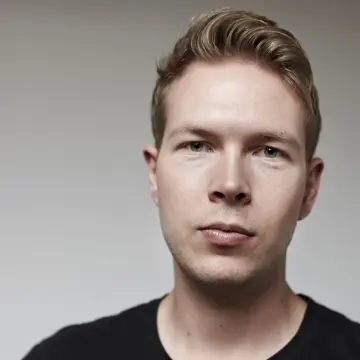
He is a senior archivist at the National Archives of Norway.
Annonse
Norway and Iceland were under Danish rule. As a result, the documents ended up in Copenhagen, either at the university there or in the king's possession.
In 1814, Norway separated from Denmark. It was then decided that some of the archives should be returned to Norway.
A coup in Bavaria
"The Norwegian authorities needed them for the administration of the country. But the medieval material was also important for shedding light on Norway’s history and identity as an independent nation in the first half of the 19th century," says Kristiansen.
Around 1820, Professor Gregers Fougner Lundh pulled off a coup. He was one of those who were passionate about the Norwegian language, history, and 'everything that determines our nationality.'
Lundh discovered that some medieval archives were located in Bavaria, in present-day Germany.
These were the archives of Christian II, King of Denmark, Norway, and Sweden, and Bishop Olav Engelbrektsson.
Lundh managed to reach an agreement with the Bavarian authorities for the archives to be handed over to Norway. From there, they would be distributed to Sweden and Denmark.
“Once these archives arrived in Norway, the Norwegians would have something to negotiate with in order to get Norwegian material back from Denmark,” Kristiansen explains.
But it took time.
Jo Rune Ugulen Kristiansen has brought out letters from the Middle Ages.(Photo: Anders Moen Kaste / Science Norway)
Demonstrations in Denmark, celebrations in Iceland
The Danes argued that the medieval material was shared property, while Iceland pointed to the Icelandic saga writers and its own history. The decades passed.
The debate over repatriation became heated. In 1961, Danish students demonstrated against the Icelandic writings leaving the country. But the transfers had already begun.
Annonse
In 1971, the largest handover took place. A Danish ship carrying the foreign minister and three books arrived in Reykjavik. The harbour was packed with people. They welcomed the Codex Regius, dating from 1270, and two volumes of the Codex Flateyensis, dating from around 1390, containing sagas about Norwegian kings.
A page from Flateyjarbók, also known as Codex Flateyensis, which contains 225 parchment pages and many illustrations. Among other things, it includes the sagas of Olaf the Holdy and Harald Hardrada.(Photo: Jón Þórðarson and Magnús Þórhallsson / Public Domain)
1,160 documents arrived, 900 remained
The largest shipment to Norway arrived in 1937. That year, Norway received 1,160 documents from Árni Magnússon’s collection at the University of Copenhagen.
"They were mainly letters, but also three land registers," says Kristiansen.
These are records of the properties belonging to the episcopal sees, including those in Bergen and Trondheim.
"Around 900 letters are still in Copenhagen. Ideally, we would get those back here as well, but we're not having that discussion right now," the archivist says.
More than half of the Danish collection consists of originals and copies from Norway, the Faroe Islands, Shetland, and Orkney, according to the University of Copenhagen.
The collections are being reunited
The fragmented Nordic collection has now been reunited.
On 14 November, Diplomatarium Arnamagnæanum launched, a website where all the documents from this collection have been published and can be searched. This makes them accessible to everyone.
"Árni Magnússon’s archive is now being brought together again. Digitally this time, with new photographs of the documents," says Kristiansen.
There will probably still be researchers who need to study the physical documents.
"But for those who are only working with the contents of the letters, photographs are sufficient," says Kristiansen.
Archivists Inga Bolstad and Jo Rune Ugulen Kristiansen in front of some of the medieval letters at the National Archives of Norway.(Photo: Anders Moen Kaste / Science Norway)
Torgeir's will
On 24 August 1310, Torgeir Petersson is in Stavanger. He is far from well, so he writes his will.
In it, he greets everyone and explains that he is physically ill but of sound mind. He then distributes money and property.
"Torgeir belonged to social elite, so he donated money for construction work and maintenance at seven different churches. He also donated a sum towards the liberation of Jerusalem, which the Muslims had conquered in 1244," Kristiansen explains.
Torgeir then chooses where he wants to be buried. He wants to be laid to rest in a prominent place in Stavanger Cathedral.
But Torgeir is not certain that his illness will kill him. The will is declared invalid if he survives.
Torgeir Petersson wanted to put his affairs in order in case he died. He gave gifts to the church, but also to his father, brothers, and two aunts. The will dates from 1310. All Norwegian documents are available via the Digital Archives.(Photo: Anders Moen Kaste / Science Norway)
Exchange of properties in 1319
There are also forgeries in the National Archives' collection of medieval documents.
"We have some of them. They are often property documents, usually made by people trying to deceive others into giving them a property," says Kristiansen.
So how could people in the Middle Ages be sure that agreements were genuine?
"Sometimes they wrote the agreement at the top and bottom of a piece of parchment. Then they wrote a word across the middle. The parchment was cut in a kind of pattern through this word," Kristiansen explains.
If they later wanted to verify the validity of the agreement, the two parties would meet and fit the pieces of parchment back together.
The agreement from 1319 is between two ecclesiastical institutions in Stavanger exchanging properties.
The word written across it is 'chirografus.'
"It isn't really that important what the divided word said. I'm not sure everyone actually knew the true meaning of chirografus," says Kristiansen. "It's Greek and simply means handwritten."
In Norway, staff at the National Archives have photographed all their documents. In Copenhagen, the process has taken longer.
"They've had the misfortune of dealing with mould, so they were delayed. But that's what happens when you work with old material," says Kristiansen.
"It's the Icelanders who have done most of the work. They will also run the database and website," he adds.
The letters date from the around 1200 to the middle of the 16th century.
The website will feature photographs of the letters and summaries in modern Norwegian, Icelandic, and Danish. The website itself will be available in Norwegian, Icelandic, Danish, and English.
The letters are tagged with keywords, allowing users to search by topic. Eventually, all personal names and place names mentioned in the letters will also be tagged.
Kristiansen himself is currently working on adding geographical information to all the documents.
"The plan is that you'll be able to search by place name. It's a huge undertaking, so it will take some time," says Kristiansen.