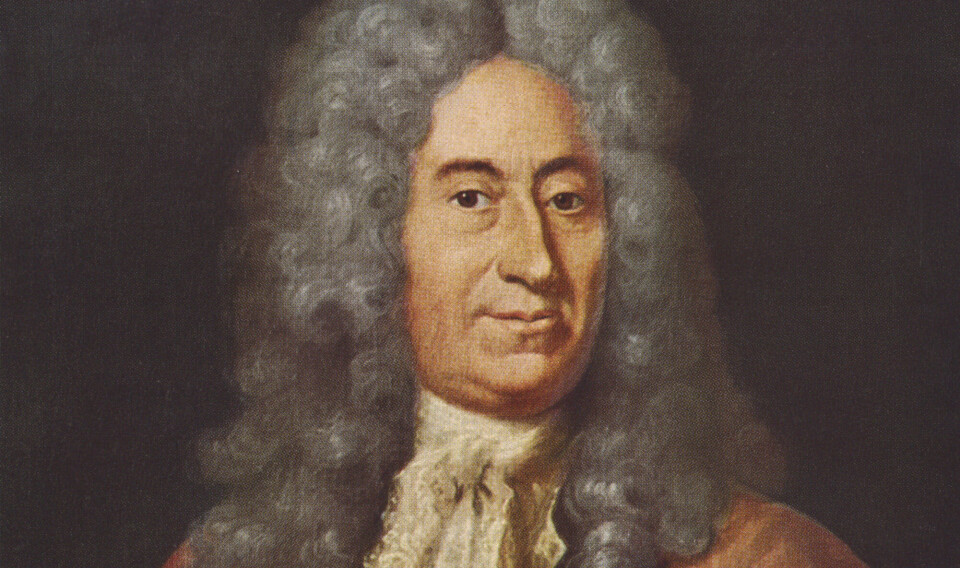
Ole Rømer was a Danish astronomer and physicist. In 1671, he travelled to Paris, where he spent ten years as a member of the scientific academy and an astronomer at the Paris Observatory, according to the Great Norwegian Encyclopedia.
In the years leading up to the discovery, Rømer and other astronomers had been closely observing Io, Jupiter's third-largest moon.
"Io regularly disappears behind Jupiter, and this regularity made it possible to use the moon as a clock," Jacob Wüsthoff Linder tells Science Norway.
He is a professor at NTNU's Department of Physics.
Rømer studied and recorded the exact times when Io disappeared into Jupiter’s shadow and when it emerged on the other side.
Discovered a pattern
Bjælde explains that because Io orbits so close to Jupiter, only one of these events could be observed on any given night.
In the days and months before Jupiter and Earth reached their closest point to each other, astronomers could observe the moon disappearing into Jupiter’s shadow.
In the period after Jupiter and Earth were closest to each other, they could see Io emerging from the shadow.
Rømer compiled detailed measurements of these events and eventually noticed a pattern.
Rømer concluded that light took approximately 22 minutes to cross the diameter of Earth's orbit, says Professor Jacob Wüsthoff Linder.(Photo: Geir Mogen)
"Rømer noticed that the eclipses occurred slightly later than expected when Earth was moving away from Jupiter, and slightly earlier when Earth was moving towards Jupiter," says Linder. "He realised that this was because the light had to travel a longer or shorter distance."
"Impressive"
Annonse
In 1676, he therefore predicted that on November 9, Io would emerge from Jupiter's shadow ten minutes later than expected.
He was correct. If light travelled instantaneously, Io should have appeared ten minutes earlier.
Rømer demonstrated that light does not travel infinitely fast, says Linder. The finding was published shortly afterwards, on December 7, in Journal des sçavans.
Rømer was not the first to suggest that light has a finite speed, but he is regarded as the first to demonstrate it with evidence.
Other philosophers and scientists had previously theorised that light has a finite speed, including the Greek philosopher Empedocles, the Muslim scientists Ibn al-Haytham and Abu Rayhan al-Biruni, and the English philosopher and natural scientist Roger Bacon, according to Wikipedia.
"How accurate was Rømer's estimate of the speed of light compared with what we know today?"
"Not very accurate by modern standards, but impressive for 1676," says Linder.
Rømer concluded that light took approximately 22 minutes to cross the diameter of Earth's orbit, says Linder. That corresponds to roughly 225,000 kilometres per second, whereas the correct value is around 300,000 kilometres per second.
"So his estimate was about 25 per cent too low. What really mattered, however, was not the exact figure, but that he demonstrated that the speed of light was finite and could be measured," he says.
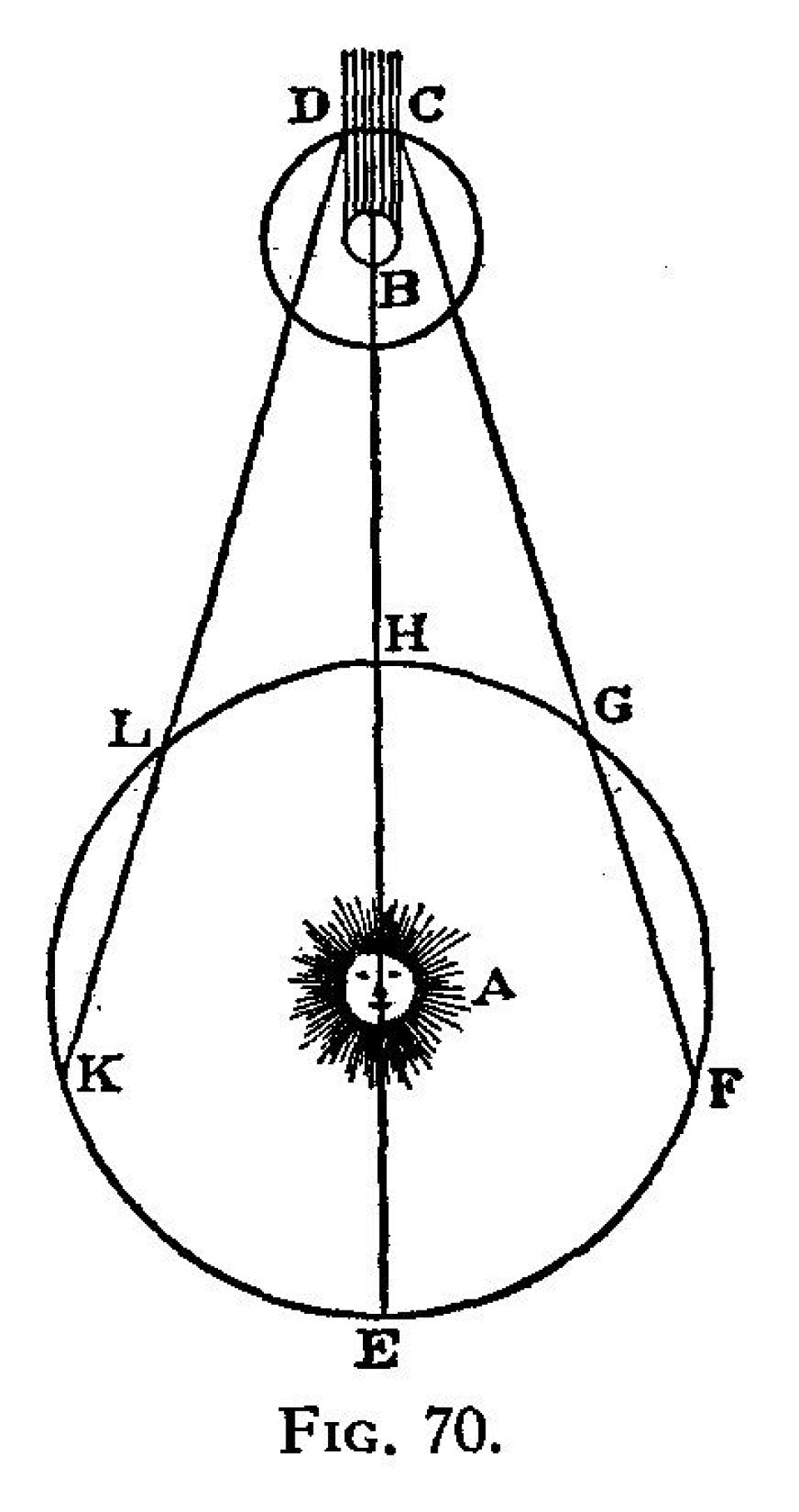
An illustration from Ole Rømer's article from 1676. B represents Jupiter, with its shadow shown by shading. K, F, L, and G indicate different observation points along Earth's orbit as Io enters and emerges from the shadow.(Illustration: Ole Rømer)
Gained support
Was Rømer's finding quickly accepted by other scientists?
"It was probably a gradual process, and there were critical voices at first. The head of the observatory where Rømer worked, for example, never fully accepted his explanation. Nevertheless, his findings received support fairly quickly from prominent scientific figures such as Huygens, and later Newton," says Linder.
Christiaan Huygens was a Dutch mathematician and astronomer. He is known for developing the wave theory of light, among other things.
"The decisive blow came with James Bradley's discovery of stellar aberration about 50 years later, which provided a completely independent and strong confirmation that light has a finite speed," says Linder.
Stellar aberration is the phenomenon in which stars appear to shift slightly in the sky throughout the year because Earth moves around the Sun while light travels at a finite speed, the researcher explains.
Looking into the past
"Rømer was the first to demonstrate that light actually takes time to travel. It was also the first time anyone had produced a reasonably realistic estimate of the speed of light," says Linder.
This became very important for astronomy.
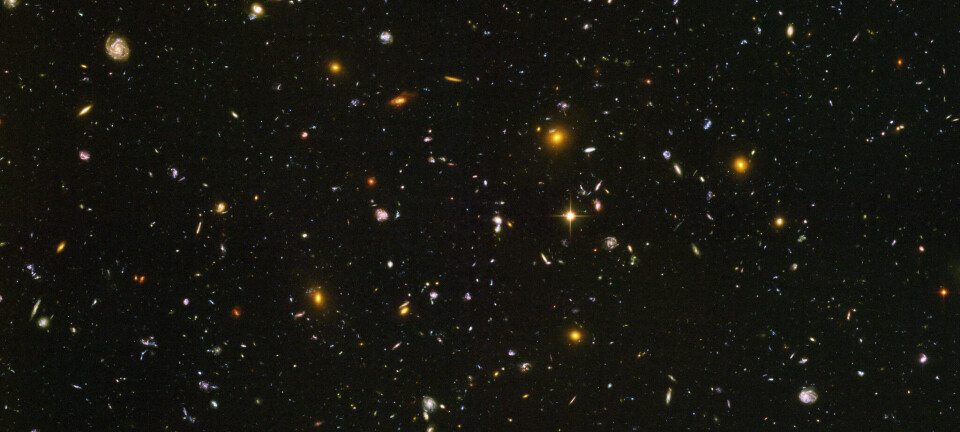
"Because when we look out into space, we are actually seeing things as they were when the light began its journey towards us. The farther away something is, the farther back in time we are looking," he says.
This has been important for understanding how the universe has evolved.