The man who saved Norway’s history from the flames
Árni Magnússon collected letters and manuscripts from the Middle Ages. Many of them are held in the National Archives, and from today they will be available for everyone to explore online.
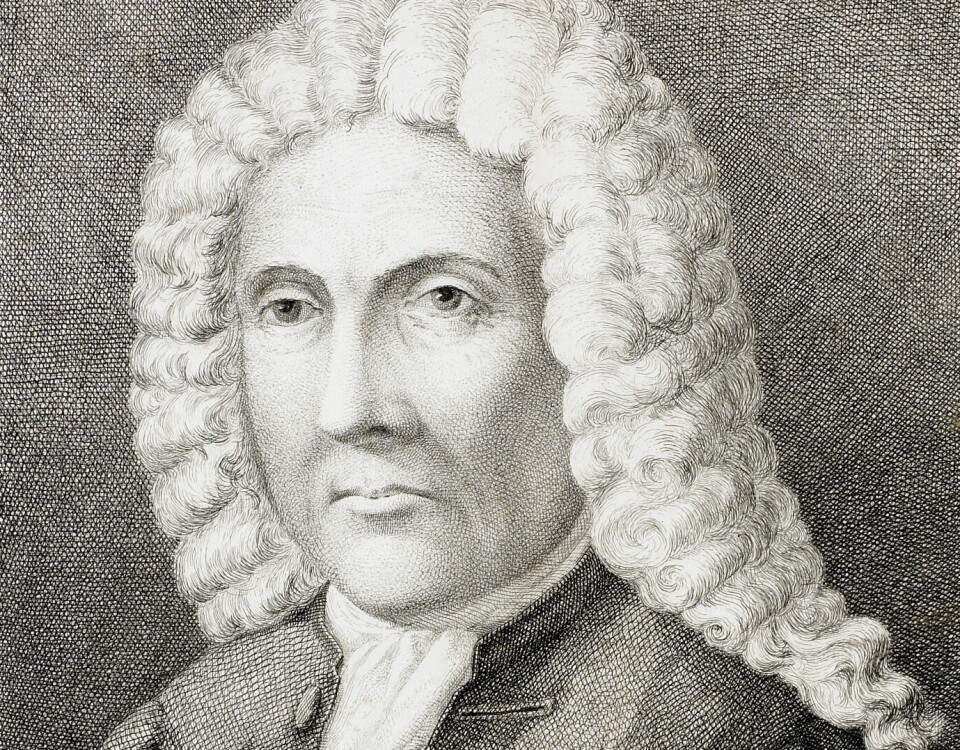
Árni Magnússon collected documents from the Middle Ages in Norway and Iceland.(Image: Unknown Creator / Public Domain)
“Well, it probably wasn't the earl himself who wielded the quill. Most powerful men had their own scribes to take care of such things,” says Jo Rune Ugulen Kristiansen, a senior archivist at the National Archives of Norway.
Earl Skule Bårdsson was one of Norway’s most powerful men at the beginning of the 13th century. He was the half-brother of King Inge and an ally of his successor, King Haakon Haakonsson, according to the Great Norwegian Encyclopedia. But Skule later rebelled and proclaimed himself king.
In 1240, he was killed by Haakon’s men.
The letter was written while they were still allies. In it, Skule sets out his wishes for what should happen after his death.
Annonse
A cheerful gathering in his honour
Skule proposed an arrangement: he would donate two farms in Trøndelag to the priests of St Olav’s Church.
In return, the priests were to commemorate the anniversary of Skule’s death every year. They would ring the church bells, hold services to pray for his soul, and distribute wax and silver to all the priests in Trondheim on his behalf.
Yet Skule was concerned with more than the fate of his soul. He also wanted to ensure his good name and reputation would be remembered and celebrated.
“The letter also specifies that, every year while Skule was still alive, the priests were to hold a cheerful gathering where they would speak favourably and entertainingly about Earl Skule,” says Kristiansen.
Skule's letter was made official with two seals and ten witnesses.(Photo: Anders Moen Kaste / Science Norway)
Skule's 801-year-old letter is one of many medieval documents preserved in the National Archives of Norway.
It has been given a place in one of the innermost storage rooms, deep inside the mountain near Sognsvann in Oslo. Here, records from the Middle Ages are kept under carefully controlled conditions.
The collection includes deeds of gift, such as Skule's letter, along with wills, property registers, and letters to and from the Church. Some are originals, while others are copies.
The oldest dates back to 1189.
The collector
One man in particular deserves credit for Norway having a collection of medieval documents today.
Árni Magnússon was a historian from Iceland. Medieval texts were his great passion.
"It's thanks to Magnússon that we have many of the kings' sagas. He ensured that texts containing Snorri's kings' sagas and other sagas were preserved and copied. He provided much of the foundation for what we know about Norwegian medieval history," says Kristiansen.
Jo Rune Ugulen Kristiansen has brought out letters from the Middle Ages. Many were collected by Árni Magnússon in the late 17th and early 18th centuries.(Photo: Anders Moen Kaste / Science Norway)
He took everything he could find
Annonse
Árni Magnússon began studying in Denmark in 1683 and later secured a job working for the Danish royal antiquarian. This marked the beginning of many journeys to Iceland and Norway in search of old handwritten texts. When Magnússon became a professor at the University of Copenhagen, he continued his work.
The texts were gathered at the university library in Denmark. Many years later, this would become a source of conflict when Norway and Iceland wanted their historical documents back.
Unlike other historians in Denmark, Magnússon understood that even fragments of letters and documents could be historically valuable. He therefore collected or borrowed virtually everything he could find.
Not everything had been well preserved. Books made from animal skin had fallen apart, while pieces of parchment had been reused to bind other printed works, Bergsveinn Birgisson writes in the book The Man from the Middle Ages.
Magnússon searched everywhere.
On one farm, he went through old, mouldy straw, according to Birgisson. There were shoes without soles, old rags and ropes, and all kinds of rubbish. Then Magnússon pulled out some crumpled scaps of dried and hardened animal skin. They turned out to be pages of calfskin bearing texts written by monks.
Magnússon became friends with the historian Tormod Torfæus, who worked for the Danish king.
"He therefore had the authority to borrow letters and manuscripts from the bishops in Oslo, Trondheim, Bergen, and Stavanger. Torfæus lent them to Magnússon, who was not particularly diligent about returning them," says Kristiansen.
When the bishop of Kristiansand wrote to Magnússon in 1705 to ask for his letters back, it was not possible to return them. Magnússon had travelled to Iceland and taken the letters with him.
"Árni Magnússon belonged to a tradition of historians and antiquarians working in Denmark during the late 17th and early 18th centuries. They searched for and collected documents from the Middle Ages. In many ways, they marked the beginning of history as an academic discipline in the Nordic countries," the researcher says.
Then, in 1728, disaster struck.
A cart with newly repaired wheels
In a house in Copenhagen, a young boy dropped a candle onto the floor.
The fire spread rapidly through the streets until it reached the university library and Árni Magnússon's collection of manuscripts and parchments.
As luck would have it, Magnússon had recently had the wheels of his horse-drawn cart repaired, Birgisson writes.
With help from people nearby, he began loading his collection onto the cart. They worked for six hours before they were forced to stop because of the flames.
"A large number of medieval documents were lost, but much of the collection was saved. Magnússon must have been quite devastated," says Kristiansen.
But without his efforts and that horse-drawn cart, we would be missing many of the sources that provide knowledge about the Middle Ages.
Records of trade, property, and rights
The oldest documents were written on parchment made from animal skin.
"Paper did not become common until the 16th century," says Kristiansen, although some letters written on paper survive from as early as the late 14th century.
The seals, usually made of wax, were intended to demonstrate that the documents were authentic and to identify who they came from.
Most of the texts were written in Old Norse or Latin, but there are also texts written in other languages.
The majority concern legal rights of one kind or another, such as the right to buy, sell, or own property. Others record agreements and legal judgements.
"We also have a few private letters, including some from Bishop Håkon Erlingsson in Bergen in the early 14th century," says Kristiansen.
These letters also ended up in the collection in Denmark and were destroyed in the fire of 1728. However, copies of the letters have survived.
19,000 pages of Norwegian history
Most of the medieval documents, also known as diplomas or charters, have been published in the Diplomatarium Norvegicum series, which is also available online.
It contains 19,000 documents. Around 7,000 of them are held in the National Archives of Norway, while the rest are in archives abroad.
Here are some of the volumes of Diplomatarium Norvegicum.(Photo: Siri Beate Gjerde / Nynorsk Cultural Centre)
Today, both original documents and copies are stored in protective boxes, wrapped in acid-free paper and shielded from light.
“They can only be exhibited for a limited period before they have to be returned to their boxes,” says Kristiansen.
200 years after the fire in Copenhagen, many of the documents were returned to Norway and Iceland.
In Reykjavík, they are preserved at an institute named after the man who saved the documents from fire and oblivion: the Árni Magnússon Institute.
Today, November 14, all the Nordic countries' medieval documents are being brought together online, making them accessible to everyone.