One of the most widely accepted frameworks for understanding personlity identifies five major traits. According to the encyclopaedia Britannica, each describes a different aspect of how people think, feel, and behave:
Extraversion: How much a person enjoys being around other people, and how sociable or talkative they are.
Agreeableness: How trusting, warm, and accommodating a person is.
Conscientiousness: How organised, orderly, and tidy a person is.
Neuroticism: How easily a person becomes worried or feels down.
Openness: How creative, curious, and open to new experiences a person is.
Together, these traits form what is perhaps best known as the Big Five. The model is firmly established in psychological research.
"This is a very well-established approach that has proven robust across cultures and studies," says Martin Tesli.
He is a professor of psychiatry at the University of Oslo and researches mental health at the Norwegian Institute of Public Health.
Tesli is one of several Norwegian researchers involved in the study.
Professor Martin Tesli is among the researchers behind the new study.(Photo: Øystein Horgmo / University of Oslo)
The largest study of personality
Researchers combined data from 46 population studies in different countries.
This is the largest study ever conducted on personality, according to Tesli.
"I am impressed by the study," says Olav Bjerkehagen Smeland.
Smeland is a psychiatrist at Oslo University Hospital and an associate professor at the University of Oslo's Centre for Precision Psychiatry. He was not involved in the study.
He explains that the researchers collected data from a very large number of people and conducted several thorough analyses.
Annonse
“This means they can draw much stronger conclusions about the relationship between genes and personality than they could in the past," says Smeland.
The researchers also investigated whether a shared family environment could explain the association. It did so only to a limited extent.
“This is an important finding because it suggests that genetic variations have a genuine influence on the development of our personality,” he says.
Linked to mental health problems
Smeland explains that the genetic variants that increase the likelihood of high neuroticism also increase the risk of several mental health problems.
“We see this particularly with depression, anxiety, and PTSD. We already knew this, but the estimates are now more precise,” he says.
However, it remains unclear whether people develop mental health problems because they are neurotic, or whether genes influence both.
“The study cannot definitively establish cause and effect. The same genes may influence the risk of both without one causing the other,” says Smeland.
He stresses that genes do not determine who will develop a mental health problem. They indicate how high the likelihood is.
“When it comes to depression and anxiety, environmental factors and life experiences appear to play a greater role than genetic differences between people," he says.
Olav B. Smeland is a psychiatrist at Oslo University Hospital and the University of Oslo.(Photo: Åsne Rambøl Hillestad / University of Oslo)
Also linked to positive traits
The association with mental health problems was strongest for neuroticism.
But Smeland notes that the study also found a genetic association between openness and several mental disorders.
“This suggests that genetic predisposition to mental health problems is also associated with positive traits that are highly valuable to society. That's an important message,” he says.
Agreeableness, on the other hand, appears to show the opposite pattern.
The genes associated with this trait were linked to a lower risk of mental health problems.
“No single personality gene”
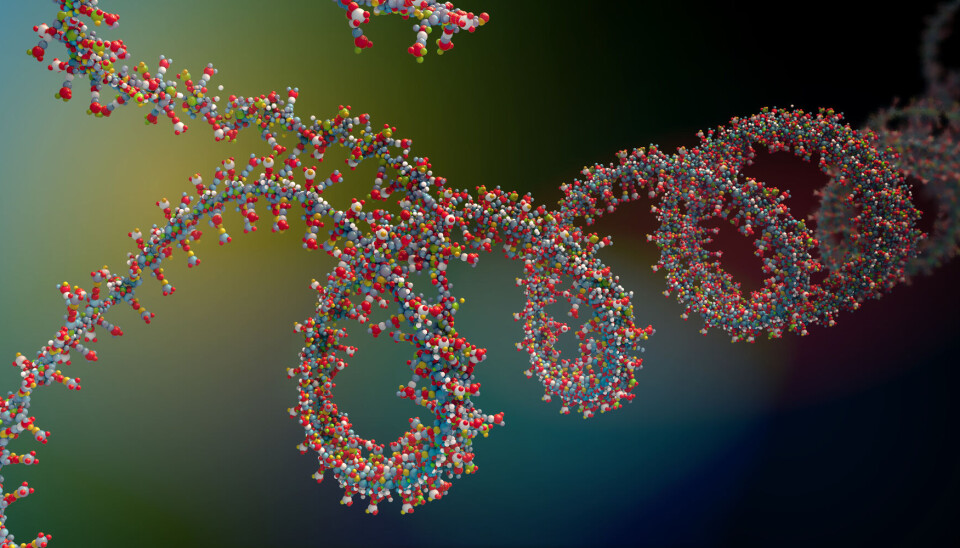
Our genetic material is a long code written using four letters. In total, the code is around three billion letters long.
Most of the code is the same in all people. But in some places, there are small differences, Tesli points out.
These differences are called genetic variants. The researchers in the study found that more than 1,200 of these were associated with personality. More than 800 of them had not been identified before.
Each genetic variant has a tiny effect.
“There's no single personality gene, or even a handful of personality genes. There are thousands of variants, each making a very small contribution to personality,” says Tesli.
Your genetic material consists of a code approximately three billion letters long.(Stock image: Christoph Burgstedt / Shutterstock / NTB)
The missing heritability
In the new study, common genetic variants explained between five and nine per cent of the variation in personality.
Behavioural scientist Rolf Marvin Bøe Lindgren has studied personality models for more than ten years.
He believes that this small percentage still matters.
"The genetic contribution is not large, but it plays an important role. Throughout the day, you make countless decisions. Genetic predispositions can influence many of them slightly. Over time, this can have quite substantial consequences," says Lindgren.
According to the researchers, however, twin studies find that around half of the differences are associated with genes.
The difference between these figures is known as the missing heritability, explains Lindgren.
"It's a bit like dark matter. We can see that the numbers don't add up based on what we have found so far. There must be something we haven't identified yet. Part of the explanation is probably that we haven't found all the genetic variants that contribute to personality," he says.
Personality is difficult to change, according to behavioural scientist Rolf Marvin Bøe Lindgren.(Photo: Studio Vest)
Can you change your personality?
If personality is partly determined by genes, doest that mean it is fixed?
Lindgren explains that even if something is hereditary, that does not mean it is impossible to change.
“How heritable a trait is does not, in itself, tell us anything about how easy it is to change. This is a myth,” says Lindgren.
Even so, personality is difficult to change.
One reason for this is that we seek out environments that suit our personalities, he explains.
Tesli also stresses that the environment a person is in matters.
“Everything that has been tested in this field points very clearly to both genes and environment being important,” he says.
Almost exclusively Europeans
Smeland points to two limitations of the study.
The study examined only common genetic variants. Including rare variants and the interaction between them could have provided a better understanding.
In addition, almost all participants were of European ancestry.
It is therefore not possible to say with certainty whether the findings apply to all ethnic groups, he points out.
“Although this issue is high on the research agenda, considerable effort is required to collect genetic data from a more representative proportion of the world’s population than has been achieved so far,” says Smeland.
Tesli points out that the study tells us something about large groups, not about individuals.
Researchers can calculate a score that indicates how likely a person is to have a high level of a particular trait.
But for any single individual, the score is far too uncertain, he stresses.
"As with a great many genetic tests of this kind, you cannot use it for anything at the individual level," he says.