









Annonse
Norwegian archaeology find of the year:
"We were wading through silver coins"
The Mørstad Hoard has been voted the discovery of the year by Norwegian archaeologists.
Published
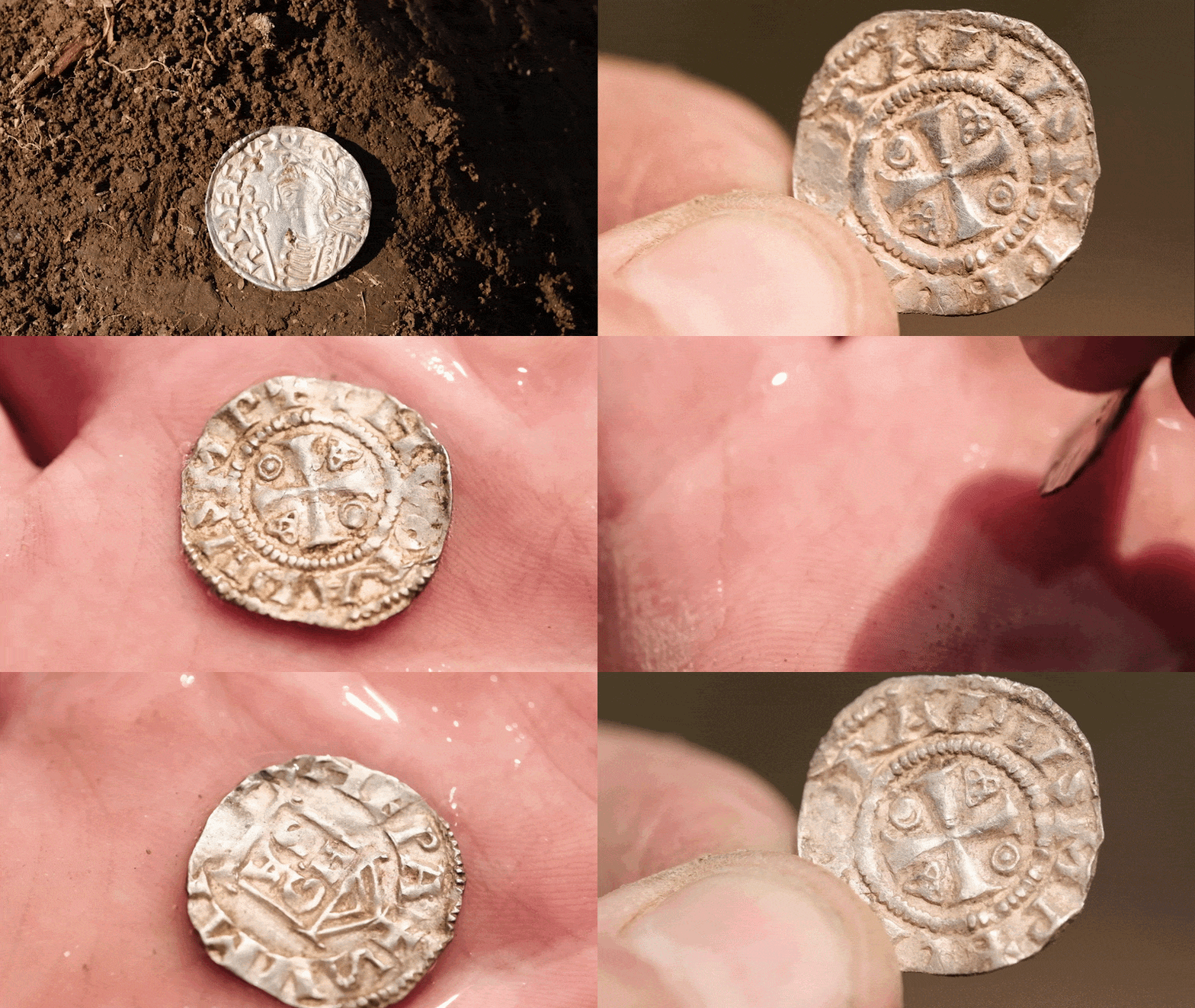
One spring day in April, a metal detector began beeping in a field at Mørstad Farm near Rena in eastern Norway.
Then the beeping became almost constant.
"We were wading through silver coins. There are six kilograms of silver. It’s pretty crazy," says May-Tove Smiseth.
The county archaeologist for Innlandet was the first to meet detectorists Vegard Sørlie and Rune Sætre out in the field. They had found 19 coins before stopping their search and contacting the county authorities.
Today, the hoard – Norway’s largest coin hoard from the Viking Age – contains 5,536 coins.
Annonse
Last Friday, it was voted discovery of the year at the Norwegian Archaeology Meeting.
.gif)
An enormous hoard – and several rare coins
It was perhaps not entirely surprising that the roughly 180 participants at the meeting voted for the Mørstad Hoard.
The find has not only broken records but has already yielded several exceptionally rare coins – including four Harald Hardrada coins, and more recently, an Olaf the Holy coin.
"Normally, finding five coins would be considered a lot," says Smiseth.
By the time the number of coins reached 3,000, the Mørstad Hoard had already become the largest Viking Age coin hoard of its kind found in Norway. The coins are also in exceptionally good condition, with several looking as though they were almost freshly minted.
Most viewed
They had to keep it secret
Suddenly becoming responsible for an enormous Viking Age silver treasure was no small matter.
Smiseth and her colleagues kept the find secret for as long as they could and had to arrange security at the site after the news broke in the media. They have spent many hours working in that field.
Excavations carried out over the summer revealed no evidence of settlements or graves. Vikings often buried their treasures for safekeeping. They were the safety deposit boxes of their time.
But something dramatic must have happened after the treasure was buried, archaeologist Kjetil Loftsgarden previously told Science Norway. You don't simply forget where you've buried more than 5,000 silver coins.

Life before and after the discovery
For metal detectorists Sørlie and Sætre, life is divided into before and after the discovery of the enormous silver hoard.
“Everything's been absolutely wild since April,” Sørlie tells Science Norway.
Annonse
“We probably won’t be able to put it into words until a couple of years have passed, when we can finally sit down and look back on it.”
Both have spent countless hours in the field since hearing that first beep, helping with searches throughout the spring and autumn.
The previous year, they had only gone out with their detectors twice.
“To be honest, there usually isn't much of interest to find in these fields,” says Sørlie, who has been metal detecting on and off since the 2000s.
After finding one of the greatest treasures a detectorist could ever hope to find, he wonders what future searches will feel like.
“We’ll have to see just how boring it gets. But we're certainly not planning to retire," he says.

18th-century porcelain on the ocean floor
In a strong second place came another surprising discovery from this year – the so-called Porcelain Wreck.
At a depth of 600 metres, archaeologists have not only found but also successfully recovered intact Chinese porcelain and parts of chandeliers from an 18th-century shipwreck.
“We had anticipated that the Mørstad Hoard and the Porcelain Wreck would be among this year’s favourites,” says Rebecca Cannell.
She is chair of the Norwegian Archaeology Meeting.
“Both are important, fascinating, and unexpected discoveries that can provide important new knowledge and form the basis for further research. In both cases, the investigations have also demonstrated just how important technology and collaboration are when exploring unexpected discoveries,” she says.
———
Translated by Alette Bjordal Gjellesvik
Read the Norwegian version of this article on forskning.no
Related content
Subscribe to our newsletter
The latest news from Science Norway, sent twice a week and completely free.


