This may be why a Viking coin hoard was buried in such an unlikely place
Something dramatic must have happened after the treasure was buried, an archaeologist believes. “You don't forget where you buried almost 5,000 silver coins.”
Who buried an enormous coin hoard here almost a thousand years ago?(Video: Museum of Cultural History)
Never before has a Viking Age coin hoard like this been discovered in Norway.
And never before in Østerdalen, far from the areas considered most central during the Viking Age.
So how did this enormous treasure end up being buried right here?
Actually, it's not strange at all, says archaeologist and associate professor Kjetil Loftsgarden from the Museum of Cultural History.
He has just completed the archaeological excavation at the Mørstad farm in Rena.
Annonse
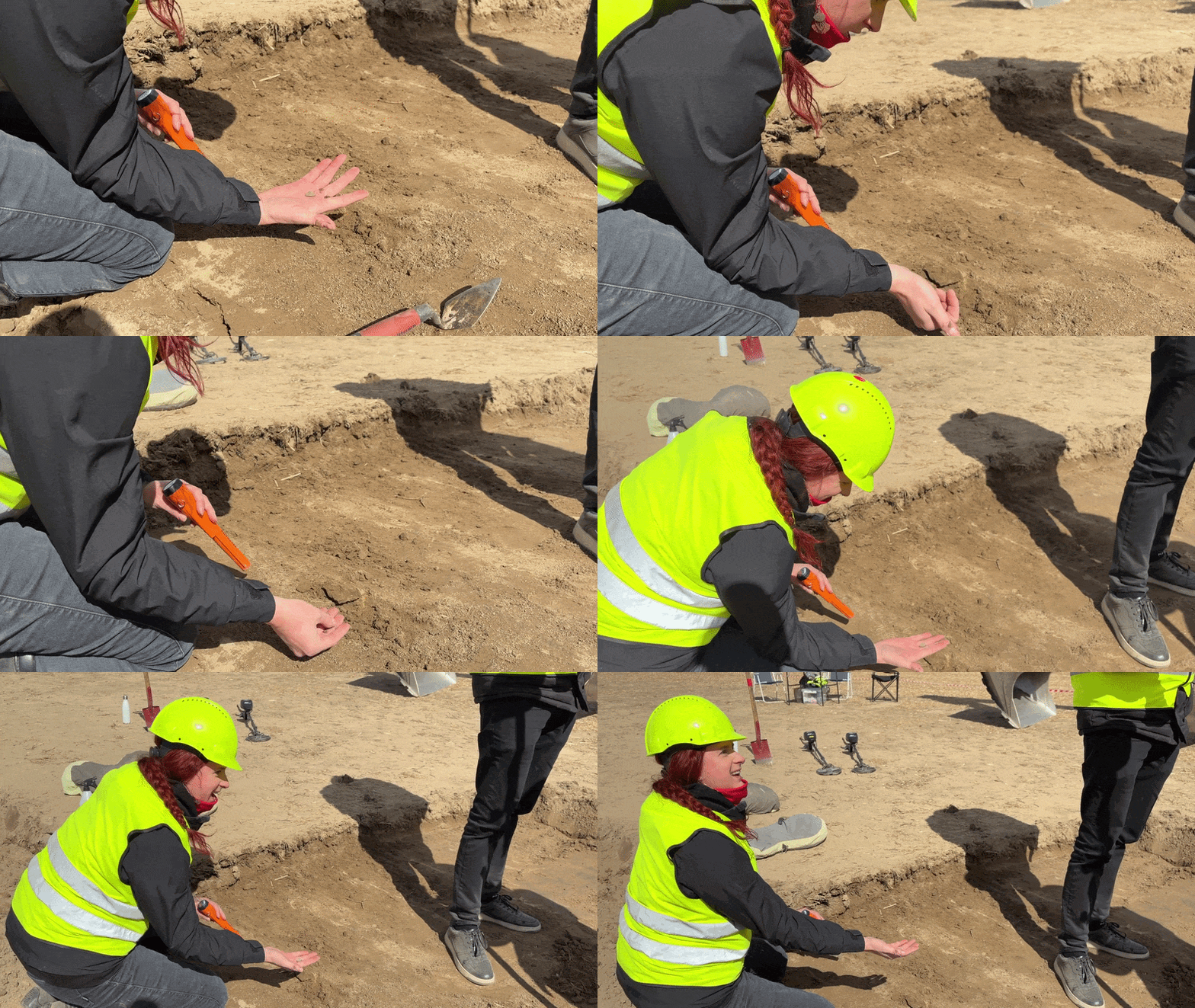
The outcome was even more coins. So far, 4,772 silver coins have been recovered from the field.
But the archaeologists found nothing else. No traces of structures or other objects.
So now the farmer is preparing to sow the field again.
A farmer with a side business
Perhaps crops were also planted in this area nearly a thousand years ago.
But the farmer was probably engaged in something else as well.
During this period, a large amount of iron was produced in Østerdalen, Loftsgarden explains. He himself has spent years researching iron and iron production during the Viking Age and the Middle Ages.
The middle of the 11th century was a time of economic growth in both Europe and Scandinavia. Populations were growing and new towns were emerging. All of Norway's medieval towns were established during this period. The power of both the Church and the monarchy was emerging.
Kjetil Loftsgarden is project manager for the excavation at Rena.(Photo: Museum of Cultural History)
And everyone needed iron.
Iron created wealth
"Iron was a fundamental part of every aspect of society," says Loftsgarden. "It was needed for farming tools, house construction, ship rivets, weapons, axes, and swords. Everyone depended on iron."
Iron production had existed throughout the Viking Age. But towards the end of the period and into the Middle Ages, production increased dramatically, Loftsgarden explains.
Denmark had no iron production of its own, so everything had to be imported from abroad, including from Norway.
Iron production was big business.
Annonse
"I think the Mørstad Hoard clearly reflects the wealth created by iron," says Loftsgarden. "Iron, bog iron ore, and control over iron held great economic and likely political importance. So actually, it's more surprising that we haven't found more treasures like this."
The archaeological investigations of the field where the Mørstad Hoard was found have now been completed.(Photo: Museum of Cultural History)
Something dramatic must have happened
At the same time, perhaps the discovery is not particularly surprising after all, he adds.
It's clear that people buried coins like this during the period. It could have been a way to safeguard wealth in troubled times. But it must be assumed that the coins were mostly dug up again, little by little, according to Loftsgarden. Like money from a bank.
"The farmer at Mørstad likely produced iron here, which generated great wealth. Great enough that he could bury a hoard of almost 5,000 silver coins. But then something must have happened afterwards," says Loftsgarden.
"Something dramatic must have happened. You don't simply forget where you buried a fortune of that size," he adds.
The challenge with the mid-11th century is that it falls between two historical periods.
The pagan burial tradition had ended, so archaeologists no longer have access to rich grave material.
And written records from the period are scarce.
"The sagas were written later and mainly focus on kings and the elite. Natural resources from the wilderness and iron production in particular have received little attention in the historical narratives about this period," says Loftsgarden.
"Hunting, trapping, and iron production are barely mentioned, even though they were very important," he adds.
Loftsgarden notes that historians have long known about extensive trade networks connecting inland southern Norway with southern Scandinavia. At Eidsborg in Telemark, whetstones were extracted and exported in large quantities to Denmark and elsewhere.
That there were extensive economic networks between the inland regions of southern Norway and the southern parts of Scandinavia is well known, Loftsgarden points out. At Eidsborg in Telemark, whetstones were extracted and exported in large quantities to places such as Denmark.
But while whetstone can remain intact underground for 1,200 years, iron is used until there is nothing left of it.
Large-scale iron production in Østerdalen
"It's quite an invisible material, apart from the numerous iron production sites found throughout the mountain and valley regions of southern Norway," says Loftsgarden.
The Østerdalen region – particularly around Rena and Åmot municipality, where the Mørstad Hoard was found – contains a large number of such production sites, the archaeologist says.
"We have long known that there was extensive iron production and export of iron to countries farther south. But until now, we have not known what values came back in return for this trade," professor and coin expert Svein Harald Gullbekk says in a press release from the Museum of Cultural History.
"This hoard is a testimony to payment on a large scale. This smells like money – the coins are not clipped or damaged in any way," he says.
More than 95 per cent of the coins in the hoard come from kingdoms located in present-day England and Germany, according to professor and coin expert Svein Harald Gullbekk.(Photo: Museum of Cultural History)
"These were the most widespread currencies in international trade at the time, and thus link Østerdalen to an international trade network," says Gullbekk.(Photo: Museum of Cultural History)
Distributed among thousands of farmers
Unlike the whetstones, which came from one large quarry and could therefore be more easily controlled, iron production was a decentralised industry.
"Each site may have been able to produce between two and four tonnes of iron. But there were thousands of them, so altogether the scale was enormous," Loftsgarden says.
The sites were spread across thousands of specialised farmers in the inland regions of Norway, the archaeologist says.
"That would have made the industry much harder for outside elites to control. It was probably organised and managed locally," he says.
No one lived here
Knut Paasche is an archaeologist at the Norwegian Institute for Cultural Heritage Research (NIKU).
He helped conduct ground-penetrating radar surveys on the Mørstad field after the coin hoard was found. Ground-penetrating radar uses electromagnetic radio waves to see beneath the surface.
The same method has previously helped archaeologists locate Viking ships. But at Mørstad, the surveys revealed nothing.
"This confirms that the treasure was not buried inside a house or at a farm. Someone hid it in a completely different place from where people actually lived," Paasche says. "If you keep your money at home, you lose it if someone comes looking for it."
Archaeologists from the Museum of Cultural History have found even more coins during the excavation.(Video: Museum of Cultural History)
Could there once have been an island there?
On the other side of the road, slightly farther from the river, lies another field, Paasche explains. Archaeologists at NIKU believe it would have been more natural for a settlement to have been located here, on slightly higher ground and farther from the river.
"The river has a strong current, and the spring floods can quickly overflow the area," Paasche points out.
His colleague Lars Gustavsen at NIKU has studied how the river changed course over time.
"His work suggests that the hoard may once have been located on an island, with someone wading out to a raised area in the river. That would make it an even better hiding place," says Paasche.
Loftsgarden’s theory places the treasure within the local community. Iron production may explain how someone in the area acquired such wealth.
But the hoard could also have belonged to an outsider.
"If you have eight men on horseback chasing you and know they will catch you before the day is over, then burying the treasure might be the smartest thing to do," says Paasche.
"For example, if someone was travelling between Trondheim to Oslo and realised, ‘I'm not going to make it with this,’ then hiding the treasure could have seemed like the best option. After all, there were no banks back then," he adds.
The search for answers continues
Paasche points out that we will never know who buried the coins or why.
But the archaeologists at NIKU hope to conduct more ground-penetrating radar surveys in the area, including on the field across the road.
"The Directorate for Cultural Heritage has said it's interesting. But we won't have time before summer," says Paasche.
Loftsgarden from the Museum of Cultural History believes there will probably be no more excavation work on the field where the hoard was found. But there may be additional metal detector searches in the autumn or next year.







.gif)