May have found the world's oldest anchor in Norway: "An incredibly exciting find"
They paddled straight out into rough seas to obtain the best stone to make axes of. On one of the trips, more than 5,000 years ago, they lost something in the water.
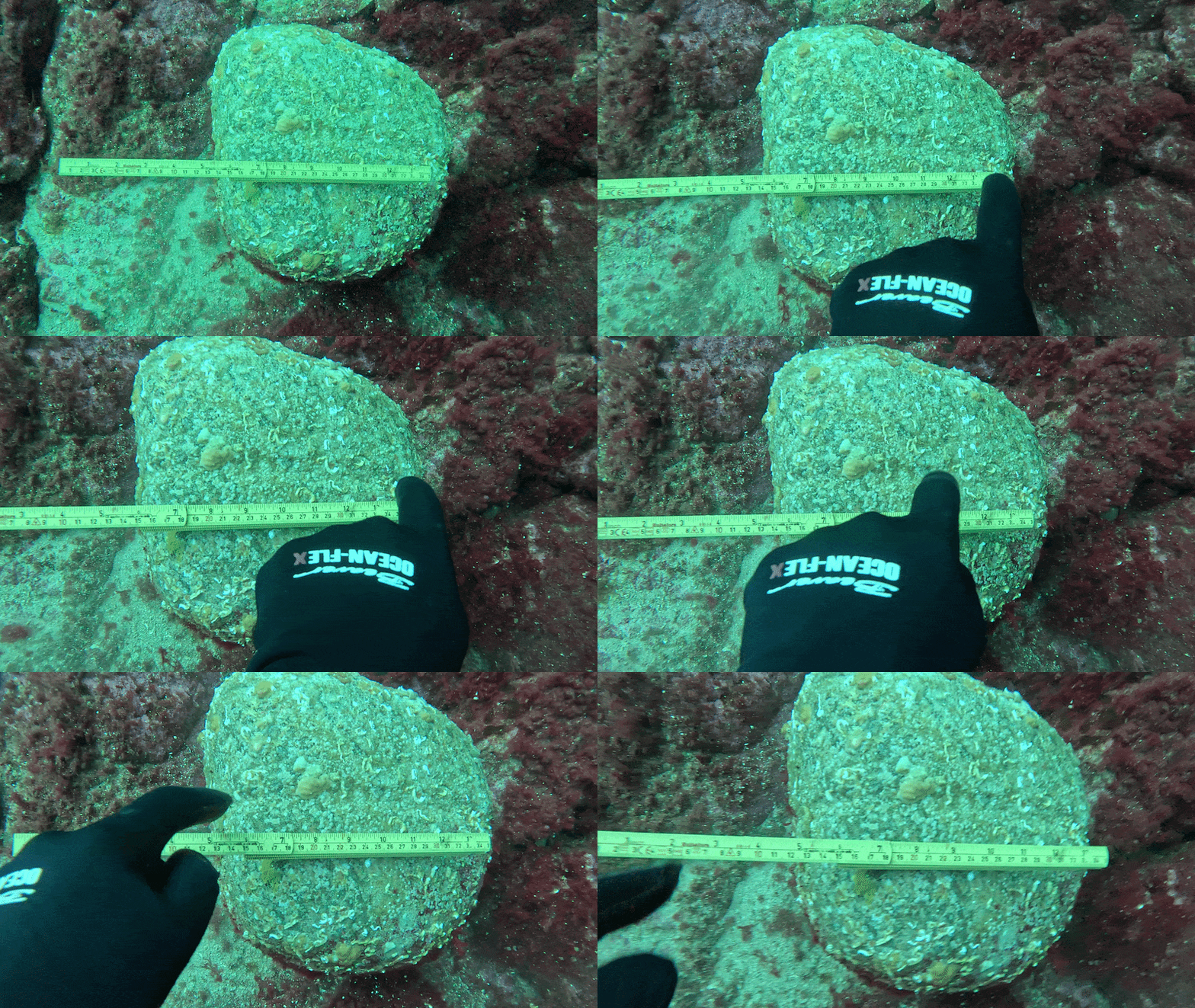
A stone with a groove, found in a waste heap in the sea, directly below a Stone Age quarry on Hespriholmen, an island in Western Norway.(Photo: Arild Skjæveland Vivås)
Five kilometres straight out into the open sea, amid strong currents and waves.
Here lies what archaeologists call Western Norway’s most iconic Stone Age site – Hespriholmen.
“It's truly dangerous water and a strange place to find yourself,” says archaeologist Arild Skjæveland Vivås of Stavanger Maritime Museum.
People paddled here between 5,000 and 9,000 years ago to quarry large blocks of greenstone, which they later made into beautiful and, over time, functional axes.
“This is a place they could only have visited when there was little wind and only small swells,” says Vivås.
Annonse
The greenstone quarry itself was discovered in 1923. Now the site is being investigated again – this time underwater as well.
And the archaeologists have found something very special.
A stone with a groove
Last year, at a depth of 20 metres on top of a heap of waste from the largest quarry on the islet, researchers discovered a stone with a distinct groove running all the way around it.
A few weeks ago, they went out there again, and this time they fastened a rope around the stone and pulled it up.
“It seemed very well balanced. Easy to pull up with a simple rope,” Vivås says.
The stone weighs more than 30 kilograms. It is therefore too large to have been a sinker for a fishing net.
"I'm absolutely convinced that this served as an anchor," says Leif Inge Åstveit from the University Museum of Bergen.
The anchor safely on land, with a distinct groove in the middle, running all the way around it.(Photo: E. Samuelsen / Bergen Maritime Museum)
The place where it was found
Åstveit has worked with greenstone from Hespriholmen for many years and is leading the investigations together with Vivås.
"Such a find almost anywhere else would not have been so remarkable. But when it's lying here in a waste heap from an Early Stone Age quarry, I have no doubt," he says.
If this is correct, then the anchor is the oldest known anchor in Norway.
And perhaps in the world as well.
The oldest reliably dated stone anchors that we know of are from the Bronze Age and were found in the Mediterranean.
Annonse
"We're really excited. We think this is an incredibly exciting find," says Vivås.
"It has to be published and peer-reviewed before we can say anything for certain. But we're a group of specialists from all over Southern Norway with expertise in underwater Stone Age archaeology. None of us has ever seen anything like it. This is very special," the researcher adds.
Arild Skjæveland Vivås from Stavanger Maritime Museum holding the anchor.(Photo: Pål Nymoen / Norwegian Maritime Museum)
Leif Inge Åstveit from the University Museum of Bergen holding the anchor.(Photo: Bruen Olsen / University of Bergen)
Did they need an anchor here?
Hein Bjerck is professor emeritus at the NTNU University Museum. The Stone Age along the coast is his speciality.
Bjerck is not involved in the investigations around Hespriholmen, but he has seen photos of the stone with the groove.
He has never seen anything like it before either.
“It's quite exciting. And very unusual. But based on the position where it was found, the fact that it was lying exactly there, I would think it's an anchor from the Stone Age,” he says.
“The weather conditions out there are harsh, and they must have brought their vessels right up to the shore to load the stone on board. So having some kind of mooring point out there would probably have been helpful," he adds.
Bjerck points out that normally, boats in the Stone Age did not have anchors. Settlements are systematically located on beaches where it is easy to pull boats ashore, he explains.
But going out to collect greenstone must have been a very special undertaking.
“And it's highly likely that they needed to stay there and have something to hold the boats in place against the pull,” says Bjerck.
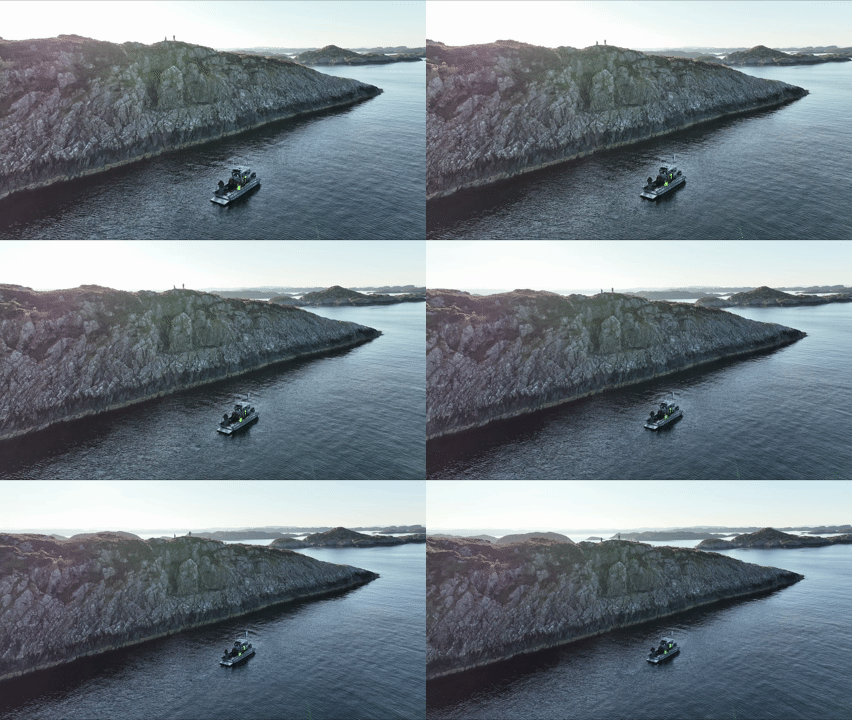
The research vessel by Hespriholmen. It's not easy to get ashore.(Video: Thomas B.O. / University Museum of Bergen)
A trace of a boat
In Denmark, logboats dating back to the Stone Age have been found. These are hollowed-out tree trunks. In Norway, there are no traces of boats from this period. There is, on the other hand, plenty of evidence of life at sea.
The newly discovered anchor is now one such piece of evidence.
For a long time, archaeologists have debated what kinds of boats Stone Age people in Norway might have used. Archaeologists in Western Norway, however, are fairly certain about one thing.
“Skin boats have been the preferred choice along the Norwegian coast. It has to do with their seaworthiness in these waters,” says Åstveit of the University Museum of Bergen.
A simple logboat would have struggled to make the journey to and from Hespriholmen. A skin boat, on the other hand, of the kind we know the Inuit farther north made, would have managed just fine, he believes.
Or did they use a raft?
But it is also possible that some kind of raft was used for the journey to Hespriholmen.
First, large quantities of firewood and tools – enormous hammerstones – had to be transported there to break the greenstone loose. Then the extremely heavy blocks of greenstone had to be transported back to the mainland. All of this had to be loaded onto and unloaded from some kind of vessel in more or less rough seas.
In addition to the anchor, archaeologists also found large quantities of these hammerstones during their most recent diving expeditions around the islet. They are made from a particularly heavy type of rock and had been transported there from the mainland.
“None of us has ever seen hammerstones that large,” says Vivås of Stavanger Maritime Museum. “It's absolutely incredible that people in the Stone Age had the knowledge and technology to travel safely out there and back again, carrying such heavy loads.”
The archaeologists have made several trips out to Hespriholmen in recent years. They have not always been able to reach it, and even when they have, it has not always been safe to go ashore.
Archaeologist Beatrice Frabetti from the Bergen Maritime Museum examines the discarded material from the quarry.(Photo: Pål Nymoen / Norwegian Maritime Museum)
The image was created using a combination of different data and shows the quarry on Hespriholmen and the underwater disposal zone.(Data from the University of Bergen, NORBIT, and Stavanger Maritime Museum)
Enormous quantities, and more than expected
The aim of the investigations at Hespriholmen is actually to calculate how much greenstone Stone Age people really extracted there.
With the help of advanced technology from the Norwegian company NORBIT, the archaeologists have mapped the area and created 3D models. In between other tasks, Åstveit spends time calculating the numbers.
In 1987, it was estimated that around 430 cubic metres of greenstone had been extracted from Hespriholmen. This is equivalent to between 30 and 40 large truckloads of material.
“We don't have the figures yet, they're coming. But we believe the amount is considerably more than that,” says Åstveit. “That tells us something about how important greenstone was in this society.”
An example of a Stone Age greenstone axe. Archaeologists believe they were particularly important objects in society at the time.(Photo: University Museum of Bergen)
Axes made of greenstone have been found at settlements from the Sognefjord down to Agder, and in some places in Eastern Norway. Archaeologists believe they may have played an important role in social life as gifts and status symbols.
During a major excavation on Bømlo 10–12 years ago, Åstveit found several tonnes of greenstone. That was when his interest in calculating how much stone people had actually extracted began.
“It's a key to understanding communication and the types of society that existed at this time, as well as the significance of these axes,” he says.
Vivås believes that Hespriholmen was probably initially a paradise for seabirds and marine mammals.
“People came here to fish, hunt mammals, and perhaps collect eggs on the islet. And then they discovered this source of greenstone,” he says.
“The fact that someone figured out they could quarry stone from an islet located far out at sea is quite extraordinary. And that they kept coming back for hundreds of generations. It puts things into perspective for us in an age when change is happening so rapidly.”
———
Translated by Alette Bjordal Gjellesvik
Read the Norwegian version of this article on forskning.no