









Annonse

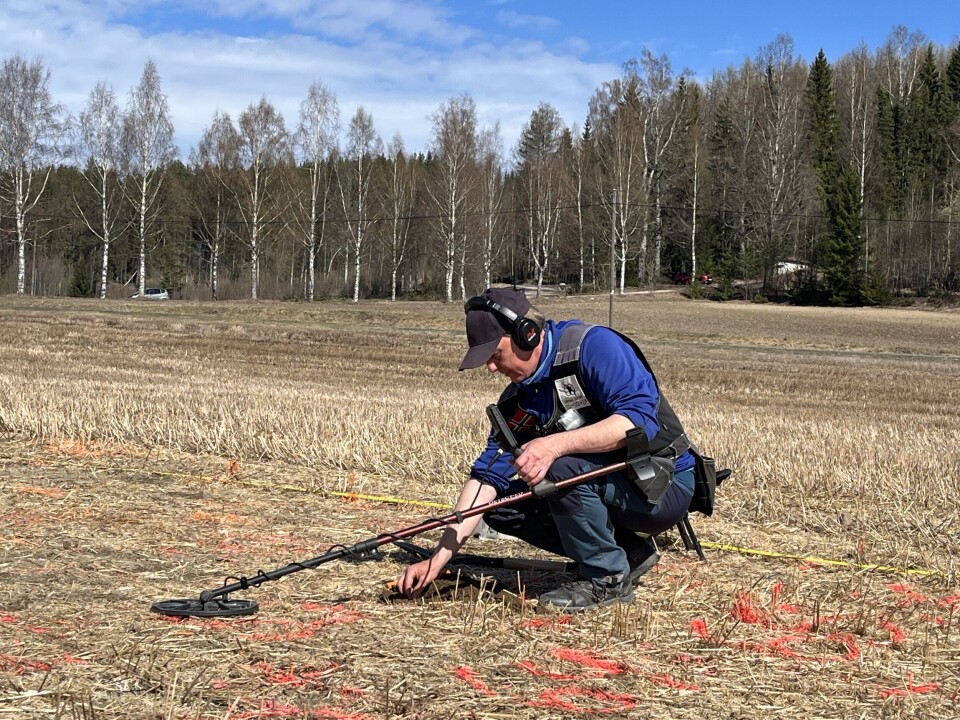
The two metal detectorists were supposed to have a gentle start to the season.
But then the metal detector started beeping.
The beeping never stopped. In fact, there's still beeping.
Because in a field at Rena lay the largest Viking Age coin hoard ever discovered in Norway.
Norway’s largest Viking Age coin hoard has been discovered: "Truly exceptional"
The metal detectors searching for coins in a field in eastern Norway still haven’t stopped beeping.
Published
"This is completely unprecedented," says May-Tove Smiseth. "It's absolutely incredible."
Smiseth is an archaeologist responsible for metal detector finds in Innlandet County Municipality.
When detectorists Vegard Sørlie and Rune Sætre found 19 silver coins in a field near Rena in eastern Norway, they realised their search had to stop. Archaeologists needed to be brought in.
"I jokingly said it would be nice if we found a few more coins to make the discovery even bigger," Smiseth tells Science Norway.
"But the detectors never stopped beeping!"
Annonse

Found more and more and more
After the first day, when archaeologists also joined the coin search, the number rose to 70.
It's unlikely we'll exceed 500, Smiseth thought.
But with each passing day, the coin discovery kept breaking more records.
This week, they passed 3,000 coins. That makes the find, referred to as the Mørstad Hoard after the farm where it was discovered, the largest Viking Age coin treasure ever discovered in Norway.
And the detectors are still beeping.
"It has been absolutely unbelievable to stand there and watch these coins be lifted out of the ground. And to see the quality of the coins. They are so beautiful," says Smiseth.
The soil at the site contains very little stone, which may explain the exceptional condition of the coins.
"They have been preserved so well that they almost look newly minted," she says.


Had to gain control first
The first coins were found on 10 April.
Following the discovery, metal detectorists and archaeologists in Innlandet sprang into action and tried to secure as much of the find as possible.
Innlandet is known for being especially skilled in training and collaborating with metal detectorists. This has led to a large number of discoveries, more than elsewhere in Norway (link in Norwegian).
"The team worked hard to recover and secure everything before we made the discovery public," says Smiseth.
Annonse

"It's not very reassuring to have such a large treasure lying unsecured. We deliberately delayed announcing it until we felt we had more control," she says.
Most of the coins were delivered to the coin cabinet at the Museum of Cultural History in Oslo on Monday this week.
Truly exceptional
There, they were received by professor and coin expert Svein Harald Gullbekk.
"This is extraordinary," Gullbekk tells Science Norway.
So far, it appears that the treasure dates from the end of the Viking Age. It was likely buried in the ground in Innlandet sometime around 1050, according to the professor.
"We have previously found Viking Age coin hoards containing around 2,000 coins, but never more than 3,000. They have broken a barrier here. This is truly exceptional. Truly exceptional," he says.
Compared with similar discoveries in Denmark, Sweden, and England, this newly uncovered Norwegian Viking treasure holds up well, according to Gullbekk.

The first Norwegian coins
He hasn't exactly had the chance to study the coins up close.
"But I have carried them into storage, packed in well-organised bags, ready for further processing," he says.
Most are German and English coins from the late Viking Age, according to the professor.
"This is typical of finds throguhout Northern Europe. You could call them the euro or dollar of the Viking Age," he says.
What makes the new Mørstad Hoard special is that it also contains Norwegian coins. These Norwegian coins must have been fairly newly minted when they were buried in the ground.
It was Harald Hardrada who established a Norwegian national minting system after he returned from Byzantium around 1045, Gullbekk explains.
"So not only is the discovery itself extraordinary, but it's also connected to a very interesting period of Norwegian history," the professor says.

Scattered by the plough
The field where the treasure was found has never been searched by metal detectorists before.
"They were lucky," says Smiseth. "They asked the landowner for permission and thought: 'Let's try that field down by the road'."
Archaeologists believe the coins were once buried in the ground in a leather pouch or some other organic material. Once this material decayed, the plough took hold of the coins and scattered them across the field.
"They were never noticed by those who work here. People don't walk the fields anymore, they sit higher up in machines," says Smiseth.
But apart from the coin find, the archaeologists have not found signs of other activity here. Not yet, at least.
In addition to continuing the intense search for more coins, they have also managed to survey the area with ground-penetrating radar. This is technology that uses electromagnetic waves to detect structures underground.
"We have not found any archaeological structures in the ground," says Smiseth.
The Vikings' safe deposit box
In archaeological terms, it's called a deposit. In everyday speech, a treasure or hoard.
And it is well known that people buried valuables during the Viking Age.
'It was probably quite common for people to hide valuables in this way. It was the safest thing people could do,' the Museum of the Viking Age writes on their website (link in Norwegian).
Most viewed
"Someone used this land as a kind of safe deposit box and concealed these valuables here," Gullbekk says about the Mørstad Hoard.
Why they did it, we will never know for certain. It could have been an offering to the gods, or an attempt to hide their fortune from thieves and war.
"What we know about these kinds of deposits that are found today is that they were never retrieved. For various reasons," says Gullbekk.
"We are probably talking about either a person or a family who stored part of their wealth in the ground here. It's interesting to speculate on what this amount could have purchased and how valuable it really was," he says.
Providing a precise answer is difficult because there are no written records of prices from the Nordic region during this period.
But based on property purchase agreements from the 1200s-1300s, this sum may have been enough to buy a farm, according to the professor.


There are probably more treasures
Gullbekk estimates that the field and surrounding area will continue to be investigated for a couple more seasons.
"When you turn the soil, additional objects often emerge, including coins that may have been missed during earlier excavations," he says. "It will also be exciting to see whether there are any traces of building structures nearby, whether there was a farm here or other man-made structures."
Gullbekk is quite certain that there are more such deposits, or treasures, to be found.
"In the Icelandic sagas, for instance, there are accounts of treasure being buried in specific places that have still not been located," he says, adding:
"There are probably quite a few treasures still hidden. Anything else would be strange."
The photo at the top of the article is taken by May-Tove Smiseth, Innlandet County Municipality.
———
Translated by Alette Bjordal Gjellesvik
Read the Norwegian version of this article on forskning.no
Related content:
Subscribe to our newsletter
The latest news from Science Norway, sent twice a week and completely free.


