Here you can gaze straight into the Eye of Africa – but what are you really looking at?
There are several things that can create such formations, says a Norwegian researcher.
This is what the Eye of Africa – the Richat Structure – looks like from space. The image was taken with the Copernicus-Sentinel 2 satellite. You can see sand beginning to drift into the rings at the bottom left.(Photo: Copernicus Sentinel data (2025), processed by ESA, CC BY-SA 3.0)
This is the Richat Structure. It is located in a very remote area in Mauritania in West Africa.
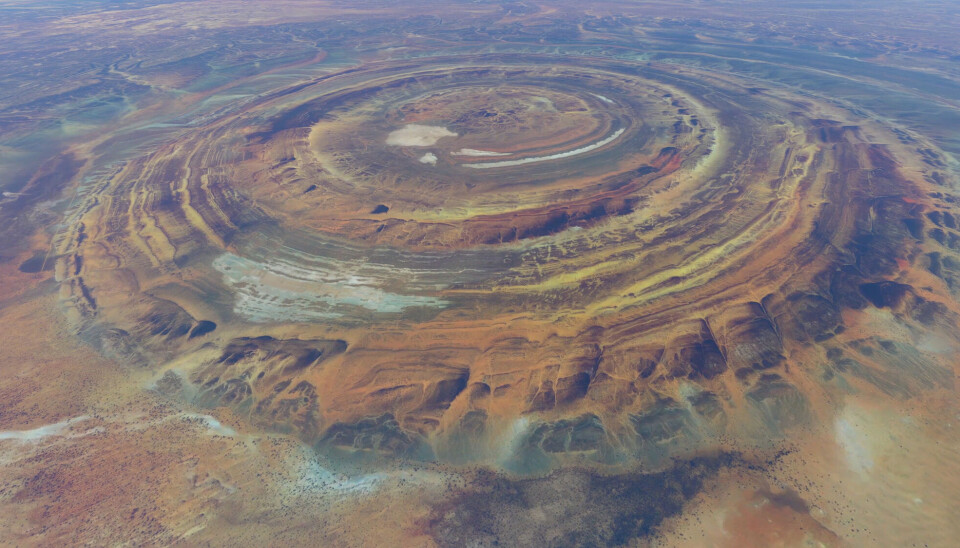
Among mountains deep inside the Sahara lies the gigantic ring structure. Rings within rings are clearly visible from space. It has an elliptical shape and is about 50 kilometres wide.
The image above was taken by the Sentinel-2 satellite, but the Richat Structure has been photographed from space many times.
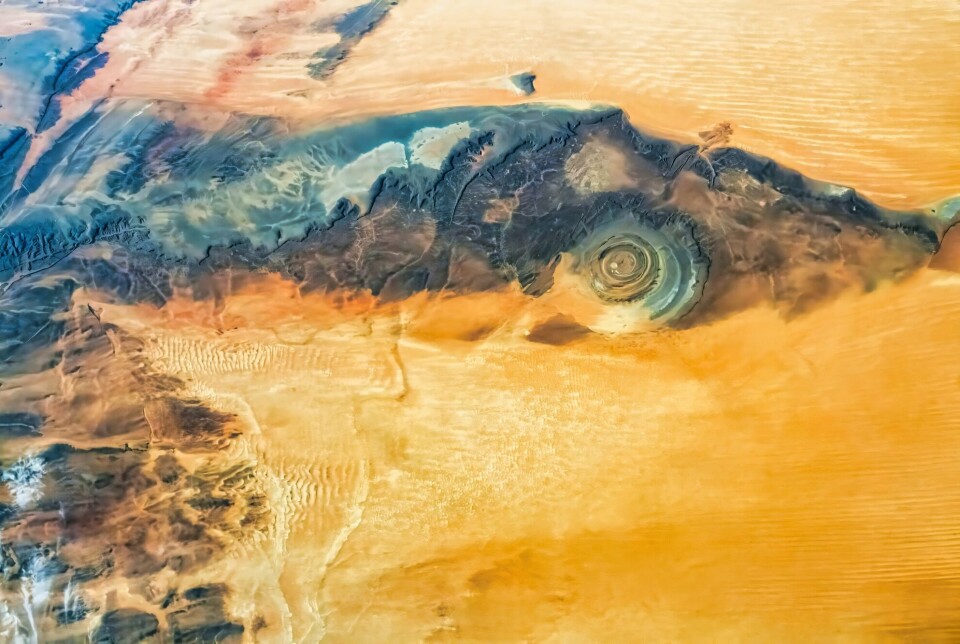
The photograph below was taken from the International Space Station in 2020. Here you can see even more clearly why the formation has been named the Eye of Africa.
A closer aerial photo of the structure located on the Adrar Plateau in the Sahara Desert.(Photo: GLF Media / Shutterstock / NTB)
But what is it? The rings look so even – at least from space – that it almost looks like a man-made structure.
Annonse
Researchers have studied the formation for many decades.
"There are a number of visually similar structures and also some that were formed in the same way as the Richat Structure," Haakon Fossen writes in an email to Science Norway. "But none that are as beautifully exposed as this one."
"Symmetrical bulging"
Several different processes can create features like the Richat Structure, geology professor Haakon Fossen writes in an email to Science Norway.
He mentions both meteor impacts and the collapse of large volcanoes as possible causes, but decades of geological and geophysical research have now revealed how the Richat Structure actually formed.
And why it appears so symmetrical and orderly.
"Its regular shape comes from a force that acted almost at a single point," he writes to Science Norway. "It's almost like a finger or a fist pushing up the centre of a stack of blankets. That creates a symmetrical bulging of the layers beneath."
The Eye of Africa seen from the space station. The name has a clear origin.(Photo: BEST-BACKGROUNDS / Shutterstock / NTB)
Magma
Molten rock, or magma, was forced upwards with great force from below, bending the layers above it. This created a dome – a bulge that rises out of the landscape.
In technical terms, this is called a magma intrusion deep beneath the surface.
The rings themselves formed because the layers in the dome consist of different types of rock that are eroded by wind and weather in different ways. Over many tens of millions of years, the top of the dome and its layers were worn away, leaving behind a series of rings around the point that was pushed upwards.
"Some rocks are hard and remain standing, while others are 'softer' and wear down more quickly," writes Fossen.
This bulge in the landscape occurred around 100 million years ago, according to an overview from the international geological organisation IUGS.
According to the organisation, the striking formation has been studied since the 1950s, when it was first discovered through aerial photography.
Annonse
So this spectacular formation is a relatively recent discovery. And it's located in Mauritania, should you wish to visit it yourself.