This simple rusk reveals two stories about Norwegian polar history
Some people ate rusks, others baked them. Norwegian polar history has both its straight and its queer sides.
A rusk on display at the Polar Museum in Tromsø. It was a staple food for the hardy men who went trapping and on polar expeditions. But those who baked it have a story too.(Photo: Nina Kristiansen / Science Norway)
Brave men conquered the poles. Strong, resilient men worked as fishermen, trappers, crew members, and heroes.
This is how Norwegian polar history has traditionally been told – also at the Polar Museum in Tromsø. But the story can also be told from different perspectives.
Silje Gaupseth is a researcher and curator at the Polar Museum. What is her favourite object?
A rusk.
Museum favourites
In this series, we ask museum staff to choose one item from their museum. What is their favourite?
Trappers on Svalbard and the crews aboard Arctic hunting vessels needed food that could survive long winters.
"Rusks were light, versatile, and extremely durable. That's why they were included in the provisions for those who went to spend the winter in the polar regions," says Gaupseth.
The people who financed and supplied the early trapping expeditions to Svalbard supplied only the bare minimum of provisions.
"That's how they saved money," she says.
Many died of scurvy, caused by a prolonged lack of vitamin C. It was not until the equipment act came into force in 1918 that the death rate declined.
Arthur Oxaas was 14 years old when he first went to the Arctic Ocean as a trapper. That was in 1902. He later spent 29 winters on Svalbard.(Photo: The Arctic University Museum of Norway)
Arthur’s love of food
Arthur Oxaas was a young trapper who enjoyed rusks, especially a dish called sluring.
The rusks are soaked and mixed with sugar and butter. The mixture is then cooked into a kind of porridge.
"It tastes really good and is incredibly filling," says Gaupseth.
When Arthur joined his first Arctic voyage in 1902, the crew received a weekly ration of rusks, half a kilogram of butter, and 200 grams of sugar every Saturday.
"He made sluring. He also made it on Sunday and Monday, but after that he had nothing left for the rest of the week except dry rusks and herring," the researcher says.
The rusk tells the story of polar food culture – of the enjoyment of food, frugality, and lack of moderation – but Silje Gaupseth also wants to tell other stories.
No women to be found
"The permanent exhibitions at the Polar Museum were created in the 1980s. They reflect the way polar history was presented at the time, with a focus on masculinity, conquest, and heroic tales," says Gaupseth.
Annonse
The so-called golden age of polar exploration is generally considered to have lasted from the late 19th century to the beginning of the 20th century. It was the era when Fridtjof Nansen and Roald Amundsen became national superstars and the great polar expeditions took place.
Rugged men in harsh conditions. That's how the story of the trappers on Svalbard is told at the Polar Museum. Here is the interior of a cabin from Wijdefjorden.(Photo: Nina Kristiansen / Science Norway)
Gaupseth wanted to challenge the male-dominated and heteronormative narratives surrounding the exploration of the polar regions.
"So I went through the exhibitions looking for women, but found almost none. Then I searched the collections using terms like homosexuality, love, and similar words, but nothing came up," she says.
The ballerina on Fram
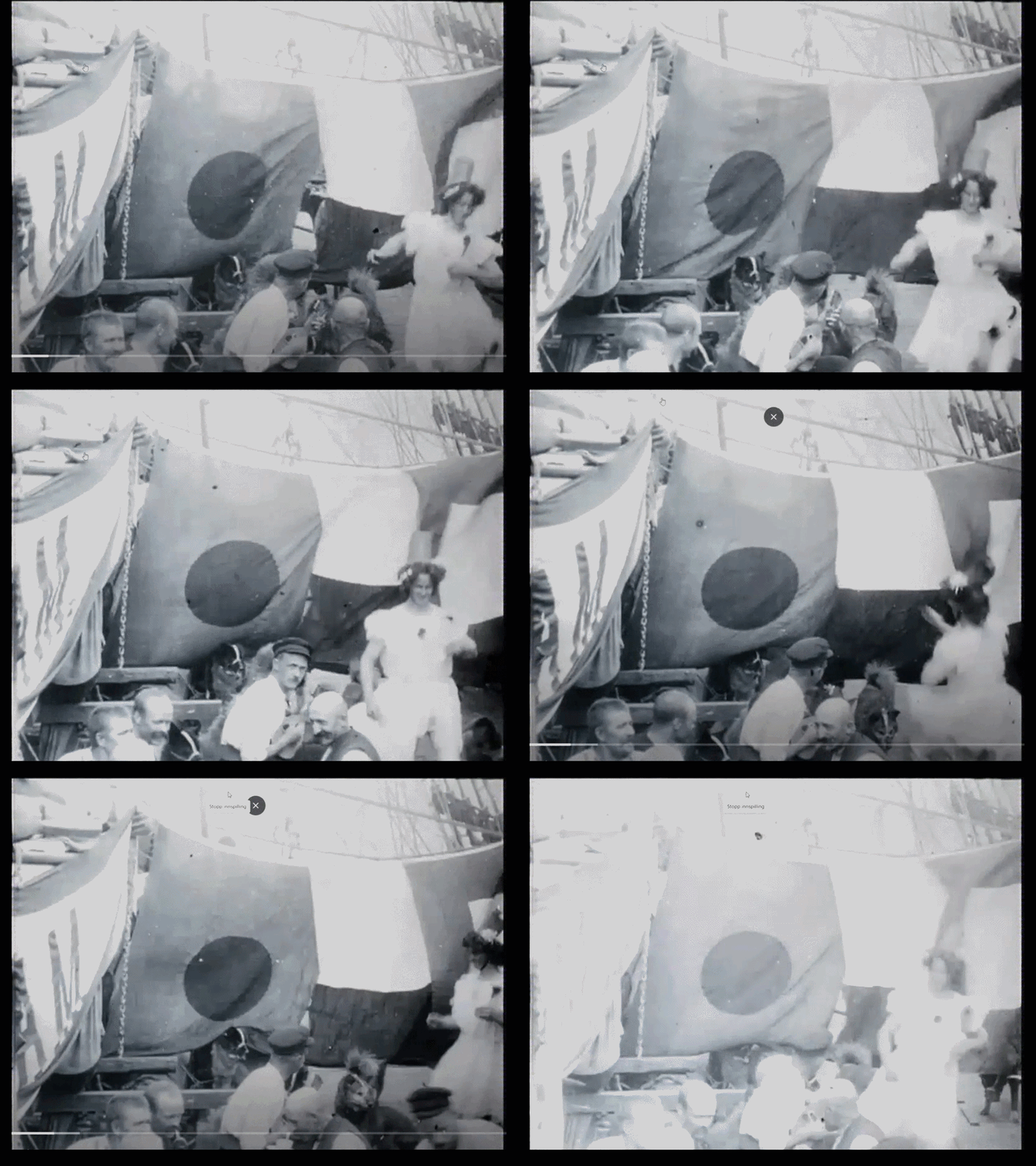
In the end, she found a small photograph in a corner of the exhibition about Roald Amundsen. It was from a party aboard the Fram, which was on its way to the South Pole. At the party marking the ship's crossing of the equator, second officer Hjalmar Gjertsen wore a dress and stockings and danced for the crew.
The video of Gjertsen’s performance is now part of the exhibition Queering Polar History.
"It was a playful moment and a welcome break from the close social environment aboard the ship. The image put me on the trail of the museum’s blind spots, the parts of history that concern departures from conventional ideas about gender and sexuality," says Gaupseth.
She looked for other stories like this. The result was the exhibition Queering Polar History, where the ship’s rusk hangs between the story of Arthur Oxaas’s sluring and the story of Borghild Krane.
Silje Gaupseth is an associate professor of polar cultural studies and director of the Polar Museum at UiT The Arctic University of Norway's University Museum.(Photo: Nina Kristiansen / Science Norway)
Borghild baked and wrote a novel
Polar history is not only about those who set out on expeditions, but also about the town that supplied the ships with equipment, clothes, and food.
The Krane family bakery supplied the rusks carried on Arctic voyages. The family's daughter, Borghild Krane, also worked for as a baker for a period.
"As provisions, the rusk is part of traditional polar history. In our exhibition, it also represents queer polar history, because while baking, Borghild was writing what would become Norway's first lesbian novel," says Gaupseth.
The exhibition on queer polar history is not intended to expose which polar heroes may have broken with the sexual norms of their time.
Borghild Krane worked as a baker in Tromsø before studying to become a librarian in the United States. She later returned to Norway, studied medicine in Oslo, and became a physician, psychiatrist, literary scholar, and an active Catholic.(Photo: The Arctic University Museum of Norway)
"That's not the point. We want to show how history is shaped, what is told, and what is left out," says Gaupseth, who is now researching Borghild Krane's story.
The erotically abnormal
While living in New York, Borghild trained as a librarian and continued writing her novel The Disarray of Emotions. It was published in 1937 and attracted considerable attention in Norwegian newspapers.
Borghild Krane portrays ‘… with the most delicate psychological understanding a young person whose erotic life most people find difficult to comprehend and judge clearly and fairly,’ according to the review published in the Norwegian newspaper Tromsø on October 8, 1937.
Another Norwegian newspaper, Aftenposten, wrote that although the subject – the erotically abnormal women – is difficult, it is ‘… a warmly human and sensitive book, well suited to fostering understanding where disgust has previously been dominant.’
New lenses
"At that time, homosexuality was regarded as a developmental disorder or a perversion, and the novel was discussed within that framework, though still in a respectful way," says Gaupseth.
The exhibition on queer polar history will soon close. It has already led to new research at the Polar Museum, including participation in Queerdom at the University of Bergen, Norway's largest research project on queer history.
"The goal is to give the public new lenses through which to see both what is present in the museum and what is missing," says Gaupseth.