A researcher gave mice unlimited Coca-Cola. Here's what happened
This is what happened to their teeth.
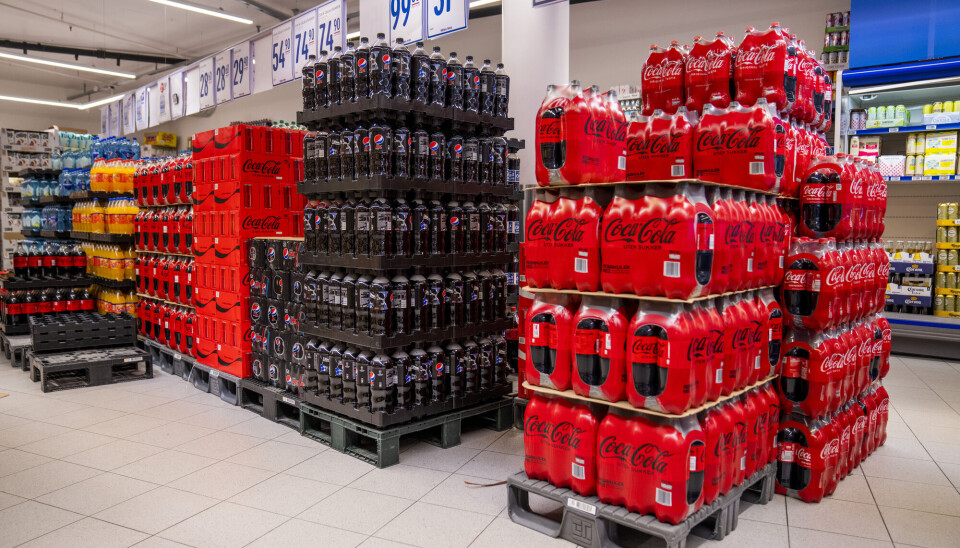
Norwegians now drink an average of around 130 litres of soft drinks per person each year. That is around 2.5 litres of soft drinks every week. The soft drinks Norwegians buy across the border in Sweden are not included.(Photo: Kwangmoozaa / Shutterstock / NTB)
Acid-related tooth damage is getting increasingly common among teenagers, according to studies.
"These are damages that can never be repaired. The acid in acidic drinks dissolves the minerals in the teeth," says Julie Marie Haabeth Brox.
She has just completed a doctorate at the University of Oslo's Institute of Oral Biology – and her work involved more than simply giving mice large quantities of coke.
Brox has also identified something that may protect teeth better than the fluoride commonly used today.
Julie Marie Haabeth Brox has researched acid damage caused by drinking soft drinks.(Photo: Jakob Chortsen / NIOM)
The experiments
Annonse
"After just two weeks, we saw a major loss of tooth substance in the mice. After four weeks and six weeks, the damage had become even more extensive," she says.
The dental researcher in Oslo also conducted another experiment.
"This second experiment involved giving mice different fluoride compounds produced in the lab, while they were allowed to drink Coca-Cola for six weeks," she says.
The researchers compared the protective effects of two commercially available fluoride compounds in the mice.
Brox and her colleagues found that metal fluorides may provide better protection against acid damage than the traditional fluoride used in toothpaste.
Stannous fluoride and silver fluoride
"The first study showed how important it is to prevent acid damage, among other things by limiting the intake of fizzy drinks and energy drinks," says Brox.
"In the second and third studies, we showed that both stannous fluoride and silver fluoride can provide better protection against acid damage than the sodium fluoride we most commonly use today," she adds.
Brox and her colleagues are not the first researchers to investigate the effect of different fluorides on tooth enamel.
There are now several studies showing that fluoride compounds containing metals, such as tin and silver, may provide better or significantly better protection against acid damage than the most common type of fluoride, sodium fluoride.
In a study of 33 people published by British researcher Nicola West and colleagues in 2019, the main finding was that stannous fluorides provided clearly better protection for teeth than sodium fluoride. The same conclusion was reached by Dutch researcher Marie-Claire Huysmans and colleagues in a study of 12 people in 2011.
130 litres of soda per person
Julie Marie Haabeth Brox carried out the three experiments as part of her doctorate.
That amounts to about 2.5 litres of soft drinks per person – every single week throughout the year.
And that does not even include the soda many Norwegians purchase across the border in Sweden.
Soft drinks and mineral water have now become the product category Norwegians buy the most of in stores. From 2018 to 2023 alone, Statistics Norway recorded that consumption of non-alcoholic beverages increased by as much as 33 litres per person per year.(Photo: Fredrik Varfjell / NTB)
"We live in a time where trends, advertising, and social media make sugary and acidic drinks highly visible and appealing, especially to children and teenagers," she says.
Label the bottles
Brox points out that notes that public health services spent more than 38 million USD in 2025 on treating acid-related tooth damage.
"What if some of this money could instead be used for more research," she suggests.
Brox believes we need more research into how acidic drinks can be made less damaging.
"It should be possible to achieve this without producers having to sacrifice flavour and commercial appeal," she says.
Finally, she points out that consumers need better information.
One practical solution would be to require producers of acidic drinks to clearly label their products with warnings about the risk of dental erosion. In other words, to tell us how acidic they are.