








Annonse
The long tails of some butterflies and moths aren’t just for show – they’re ingenious
Researchers used to think the tails were so long to attract females. Now they have a new theory.
Published
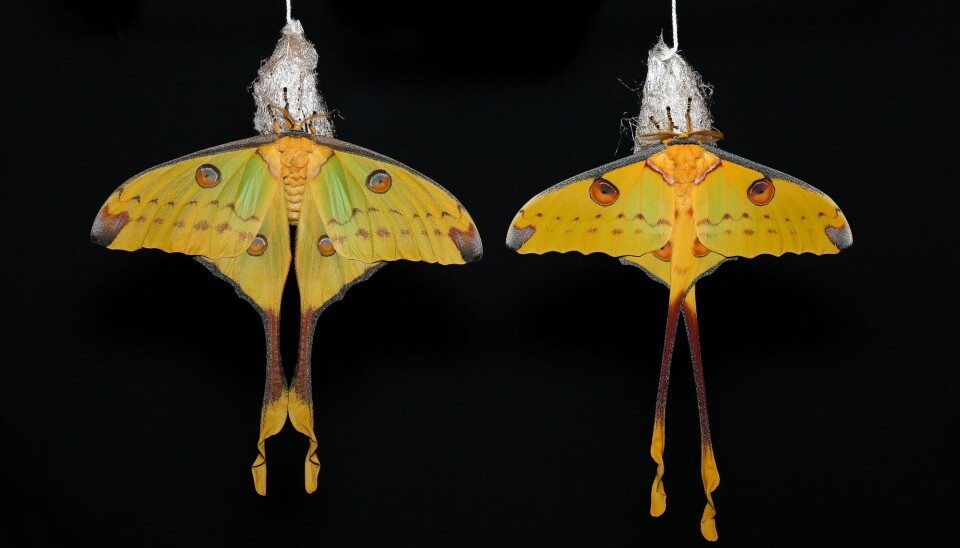
Some butterflies and moths have tails.
Moon moths, for example. The male has a longer tail than the female, and it's so long that it seriously hinders him when he flies.
This is explained by Hallvard Elven. He researches insects at the Natural History Museum in Oslo.
Researchers do not agree on why butterfly and moth males have such long tails.
"We used to think that the tails made them attractive to females," says Elven.
Annonse
Animals with a lot of decoration get eaten first
This explanation is called the handicap theory.
In several animal species, males have ornamentation that's not very practical. The male peacock, for example. Its large and long tail makes it difficult to sneak away from predators, but the tail is beautiful and impresses females.
"The same applies to males that have strong, bright colours, while females are grey, brown, and blend into their surroundings. Guess who gets eaten first if a fox shows up," says Elven.

Females prefer males with strong colours or beautiful tails. And during the mating season, males use their ornamentation to impress.
"The theory suggests that females choose the males with the most ornamentation. If they have survived despite the handicap, they must be strong and healthy with good genes," says Elven.
Most viewed
And females do not need to worry about their daughters, because they do not inherit the handicap. They become brown and well camouflaged without tails.
"But they can inherit the cleverness and all the other good genes that the male has," says Elven.
Bats miss their target
New knowledge has now emerged, offering another explanation. Let's call it the bat theory.
Because bats are the worst enemies of moths that fly at night.
Bats navigate in the dark by emitting loud cries. The sounds hit objects around them, like trees and walls, and bounce back as echoes.
Bats use the echo to understand where things are – and to find food. When the sound hits an insect, they adjust their speed and direction, send out more cries to determine exactly where the insect is – and strike.

"When a bat's call hits a butterfly or a moth with a tail, the echo is sent back in a way that confuses the bat. As a result, it often misses its target," says Elven.
Annonse
The bat theory has been tested by researchers in experiments.
"The results show that the long tails distort the echo signals, so we're now starting to become confident that this theory may be correct," says Elven.

Birds can also be fooled
The tails can also confuse other predators.
Birds may think they are the insect's antennae.
The swallowtail is active during the daytime and must watch out for birds. Both the male and the female have a small tail and a red eyespot on each wing.
"You’ll often see swallowtails that have lost their tails because a bird attacked them, thinking the tail was the antenna and the eyespot was the head. They end up striking the wrong end," explains Elven.
———
Translated by Alette Bjordal Gjellesvik
Read the Norwegian version of this article on ung.forskning.no
Related content:
Subscribe to our newsletter
The latest news from Science Norway, sent twice a week and completely free.


