









Annonse
How is ice able to hold so much weight?
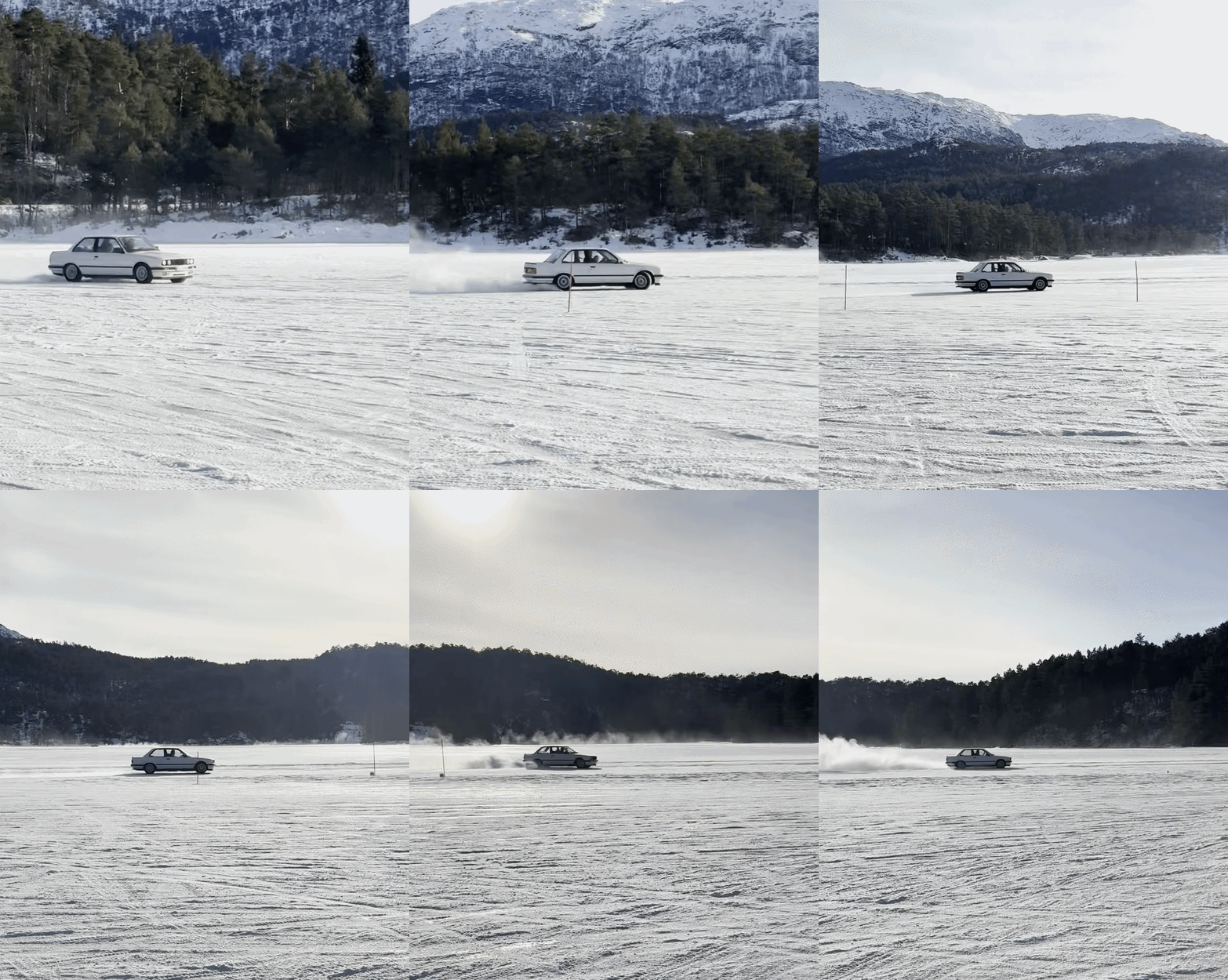
ASK A RESEARCHER: "In very cold areas, the ice can become so thick that it can be used as a road," says a researcher.
Published
You can easily crush ice cubes in a soft drink with your teeth.
Yet ice covering a lake can support people, cars, and trucks moving on top of it.
"My dad used to drive straight across the frozen lake to get to work faster," Marianne Konow tells Science Norway.
In summer, he had to drive all the way around.
So how is ice able to hold so much weight?
Annonse

Both fragile and strong
"Ice is both strong and fragile at the same time," says Einar Ólason.
He studies how ice forms, moves, and cracks.
"Ice can withstand a great deal, but if it breaks, it happens very suddenly," he says.
Because of this, driving on ice is strictly regulated.
It's generally prohibited in Norway unless it is necessary or you receive special permission, writes Norwegian broadcasting corporation NRK.
Locks together
When water freezes, something special happens.
"The water turns into tiny building blocks called crystals," he says.
These crystals lock into a fixed arrangement known as a crystal lattice.
When pressure is applied, this lattice holds the ice together. But if the load becomes too heavy, the structure can crack.

Using ice as roads
Ice is not as strong as steel or concrete.
"But if it becomes thick enough, it can handle quite a lot," says Ólason.
Annonse
To find out whether it is safe to walk or drive on ice, you must measure its thickness.
- Around 10 centimetres: You can walk on the ice.
- Around 30 centimetres: The ice can support a regular car.
- 50-70 centimetres: The ice can support a truck.

Water provides support
Ice on water has a major advantage.
"It floats on the water," says Ólason.
Just like ice cubes float in a glass, lake ice rests on the water because ice is lighter than water.
"Unlike a bridge on land, the ice does not need to carry its own weight. It only has to support what's on top of it," he says.

Ice roads
"In very cold areas, the ice can become so thick that it can be used as a road," says the researcher.
But then you need permission from the police.
This has been done in Norway. For example on Lake Mjøsa, Norway's largest lake. Instead of driving all the way around, people have simply driven across it.
Marianne Konow grew up by Lake Mjøsa. Her father worked as a priest on the other side.
"We simply drove straight across the ice to get to church," she says.
According to Ólason, people in Sweden, Finland, and Canada also build ice roads.
Most viewed
Cold ice is the safest
When making ice roads, snow is often cleared away. This makes the ice safer, because snow works a bit like a warm jumper.
"The ice becomes colder and thicker without the snow," says Ólason.
Temperature matters a lot. When it gets warmer, the crystals let go of each other more easily.
"That makes the ice in spring more dangerous than the ice in winter. Even if they are the same thickness," says Ólason.
Warning signs
To check whether ice is safe, measure its thickness and look for cracks.
"Numerous cracks suggest that it may collapse. That's a clear warning sign," says Ólason.
Another warning sign is water being pushed up through the ice.
"That indicates too much weight is pressing down on it, such as from cars or people," he says.
If you find yourself on unsafe ice, the advice is to lie down flat.
"When you stand, your entire body weight presses down on a small area. If you lie down, the weight spreads out," he says.
This makes it easier for the crystal lattice to hold.
It's important to study ice
Ólason says we know a lot about how ice grows, melts, and cracks.

"But we know less about how small changes affect large ice-covered areas like fjords and bays, or even the entire Arctic Ocean," he says.
The climate is getting warmer and the ice is becoming thinner.
"That makes it even more important to understand how ice behaves," he says.
Researcher Thomas Correll Jensen agrees. He studies how climate change causes ice to melt faster. He has studied Lake Atnsjøen by Rondane National Park.
"It remains ice-free for about three weeks longer than it did in the early 1950s," he says.
Climate change and warmer air are the main reasons.
"The ice forms later and melts earlier," he says.
In some places, ice may disappear altogether. Denmark, with its milder climate, has already seen several lakes remain unfrozen.
"In Norway, most lakes will still freeze in winter, but for shorter periods," he says.
These changes affect more than ice skating and driving across ice.
"Changes in when the ice melts can affect fish, small animals, and plant life," he says.
———
Translated by Alette Bjordal Gjellesvik
Read the Norwegian version of this article on ung.forskning.no
Related content:

Subscribe to our newsletter
The latest news from Science Norway, sent twice a week and completely free.


