There have been
40 to 50 ice ages in Norway in the past 2.6 million years, researcher Jan
Mangerud recently told Science Norway.
During the ice ages, Norway was covered
by huge glaciers. It would not have been possible to live
here.
Over the past one million years, ice ages have come in a rhythm of about 100,000 years,
separated by warmer periods that have lasted between 10,000 and 15,000 years.
We are now
living in an interglacial period with a milder climate, called the Holocene,
which began 11,700 years ago.
Does this mean
that the next ice age is approaching? That's what Science Norway's reader
Harald from Oslo wanted to know.
Annonse
“It should be within 5,000 years if the 100,000-year cycles continue.
Could you follow up on this?” he wrote to the editorial team.
We have asked Andreas Born. He is a professor at the University of Bergen’s Department of Earth Science and studies past
climates.
Unusually long interglacial period
“The next ice
age will probably not begin for another 50,000 years,” says Born.
Researchers
have arrived at slightly different estimates. If we disregard human
influence, the current interglacial period is estimated to last between 10,000 and 50,000 more years.
We are
therefore living in an interglacial period that is unusually long.
“It's
already longer than the last interglacial period,” says Born.
The last time
there was a particularly long interglacial period was 400,000 years ago.
The reason this
interglacial period is especially long is because of natural fluctuations in
something called Milankovitch cycles, says Born.
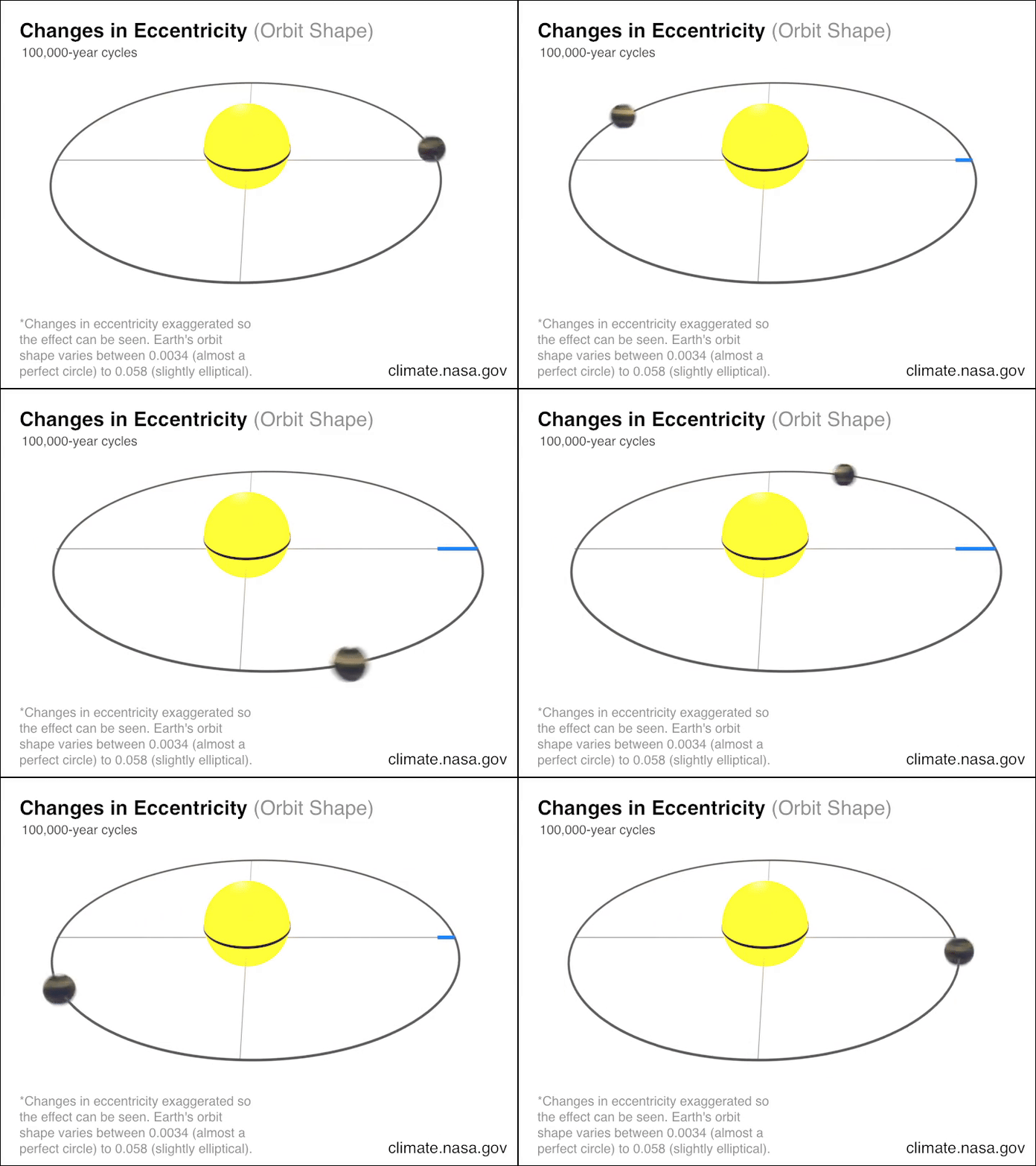
These are
changes in the Earth's orbit, from circular to elliptical, as well as changes
in the Earth's tilt and wobble, which affect solar radiation.
These cycles
have periods of 100,000, 41,000, and 17,000 to 21,000 years. They control the
timing of the ice ages and interglacial periods, along with feedback mechanisms
in the climate system.
Circular orbit
We are now in a period when the cycles and other factors don’t provide
the right conditions for a new ice age to begin.
“This is
related to the fact that eccentricity is currently relatively low, meaning that
the Earth's orbit is almost circular,” says Born. “This means
that the solar radiation in the summer is neither unusually high nor unusually
low.”
Annonse
For a new ice
age to begin, summer temperatures need to be lower than normal so that snow
can survive from one winter season to the next, build up over time, and form
glaciers, Born explains.
“The last
interglacial period ended when the eccentricity was high, but that’s not the
case now,” he says.
Illustration of the Earth during the last glacial maximum.(Image: Ittiz, CC BY-SA 3.0)
Should the ice age have already started?
Most researchers
agree that the next ice age will not come for several thousand years.
Some, however, believe that the ice age should already have started, but has been postponed.
“There are
people who assume that the next ice age had already started before we started
emitting greenhouse gases, and that the Little Ice Age was actually the
beginning of what could have been a new ice age,” says Born.
The term
neoglaciation refers to the period when the climate gradually became cooler and
glaciers grew after the warm period in the early Holocene, as described in Geophysical
Research Letters.
The Little Ice Age is
a term that describes the climate from the 14th century to the 19th century,
when glaciers expanded.
A hypothesis
by William Ruddiman sugests that the next ice age should have already begun, but
has been delayed due to deforestation and early agriculture that started several thousand years ago.
Greenhouse gases play a role
An important
factor for when the next ice age will come is greenhouse gas emissions.
The CO2
content in the atmosphere has increased, and the planet has become warmer.
Simulations using
climate models can see how greenhouse gas emissions will affect when the next ice
age begins, says Born.
“These estimate
that with the emissions we have already had, the next ice age will be delayed by at least 120,000 years from today, perhaps as much as 200,000 years,” he
says.
The researchers
write that under natural conditions, the next ice age is expected 50,000 years
into the future, and that emissions to date are not enough to delay it further.
If we emit
twice as much as we have so far, the next ice age will begin in 100,000
years. This doubling of emissions is expected by 2070 in climate change scenarios
with moderate emissions.
The researchers
also write that the next ice age is likely to start within 200,000 years, even
with extremely high greenhouse gas emissions.
Could it be more than half a million years?
Other studies
have produced different estimates.
“We don't yet
know how much carbon dioxide will accumulate in the atmosphere, but it could be as much as half a million years until the next ice age,” says Born.
In a study
published in Earth System
Dynamics in 2021, the conclusion was that high emissions could delay glaciation by half a million years.
The next ice
age will therefore come somewhere between 50,000 and 500,000 years in the
future, Born summarises.
If there ever
is another one.
“If a new ice
age were to come, cities like Oslo, Stockholm, and Chicago would be covered by
several thousand metres of ice. In that case, it's probably highly unlikely that humans would allow this to happen again, as long as there's a society,” he says. "That could mean that the last ice age was actually the
last ice age.”