Fluid flows from the Earth's interior near Norway's deepest hole
The find provides a rare opportunity to examine processes similar to those that shaped the Earth in its early days – and perhaps also ocean worlds on other planets, according to the researchers behind the find.
The discovery was made here, close to Norway's deepest hole, the Molloy Deep.(Map: UiT The Arctic University of Norway)
Researchers working from the vessel Kronprins Haakon and using Norway’s remotely operated underwater vehicle Ægir 6000 have uncovered something remarkable in the Arctic, northwest of Svalbard.
The trench plunges several thousand metres into the seafloor.
Its formation is driven by tectonic forces as the crustal plates of Europe/Asia and North America/Greenland drift apart.
This is also how new, young seafloor is constantly being created.
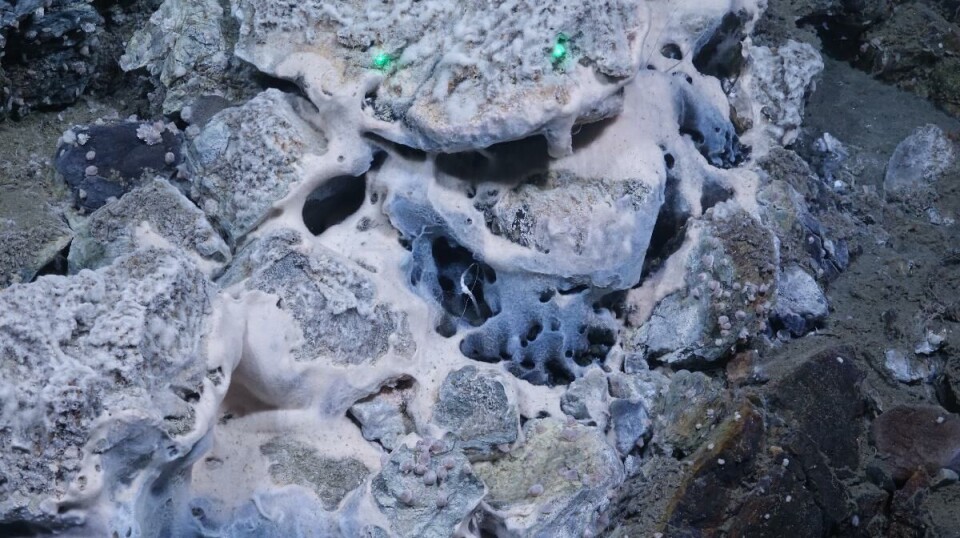
In the areas where warm, gas-rich fluid rises from the seafloor, researchers from UiT The Arctic University of Norway discovered unusual bacterial communities that feed on methane.(Photo: EXTREME25 Expedition)
There are also some organisms that thrive at a depth of 2,700 metres, where methane-rich fluid rises from the young seafloor.
"What first appeared as bare rock revealed whitish bacterial filaments and mats likely supporting more complex organisms," researchers Claudio Argentino and Ines Barrenechea said in a press release from UiT.
From the lower part of the crust
Early examinations show that the site, named Frigg, supports a variety of life, including snails, crustaceans, tube worms, and fish.
Researchers link this unique deep-sea ecosystem directly to the warm, methane-rich emissions.
The shimmering fluid they observed indicates ongoing activity deep beneath the seafloor.
This may help researchers understand how life can survive in extreme environments. It might also shed light on how the very first microbial life on Earth emerged, according to the researchers.
Methane gas that could be extracted
The EXTREME25 project in the Arctic is led by researchers from UiT The Arctic University of Norway, and includes researchers from the University of Bergen and research institutes in Italy, Denmark, Iceland, and the USA.
According to UiT, the chemistry and structure of the rocks make the area a promising candidate for the production of abiotic methane.
This type of methane forms through reactions between water and rock rather than from biological sources.