When the Russians invaded Chornobyl, the wildlife cameras were still running
They have provided unique data on how animals respond to war.
FILE - A radiation sign is seen near a broken Russian vehicle with a V letter, a sign of the Russian army, close to the Chernobyl nuclear power plant in Chernobyl, Ukraine, April 16, 2022. (AP Photo/Efrem Lukatsky, File)AP Photo/ Efrem Lukatsky
On February 24, 2022, Russian forces entered Ukraine. They quickly took control of the Chornobyl area, as it is called in Ukrainian, before being driven out on March 31 of the same year.
Svitlana Kudrenko
Prior to that, Ukrainian researcher Svitlana Kudrenko and her colleagues had set up wildlife cameras to study lynx in Chornobyl.
When the Russians attacked and bullets were flying, the wildlife cameras continued capturing images of the animals in the area. Meanwhile, Kudrenko was working on her PhD.
Andreas Zedrosser is a professor at the University of South-Eastern Norway. He supervised Kudrenko and realised they had something truly extraordinary.
“We thought this was a unique opportunity to see how animals respond to war,” he says.
Zedrosser adds that we already know quite a lot about what war does to the landscape.
“But war changes not only the landscape, it also changes the behaviour of the animals living in it. It became a completely unplanned experiment," he says.
"It's important to mention that I didn't want to obtain this data," says Svitlana Kudrenko.
How the war has affected her as a researcher is a long story, Kudrenko says. She is currently living in Poland.
Svitlana Kudrenko
The Chornobyl exclusion zone is itself of great interest to researchers studying ecology and wildlife.
Kateryna Korepanova
Following the 1986 nuclear disaster, a 2,600-square-kilometre area was closed off to people.
Et forfallent anlegg står ved bredden av en innsjø i Tsjornobyl-området.Kateryna Korepanova
Since then, nature has gradually reclaimed the abandoned landscape in a process known as rewilding.
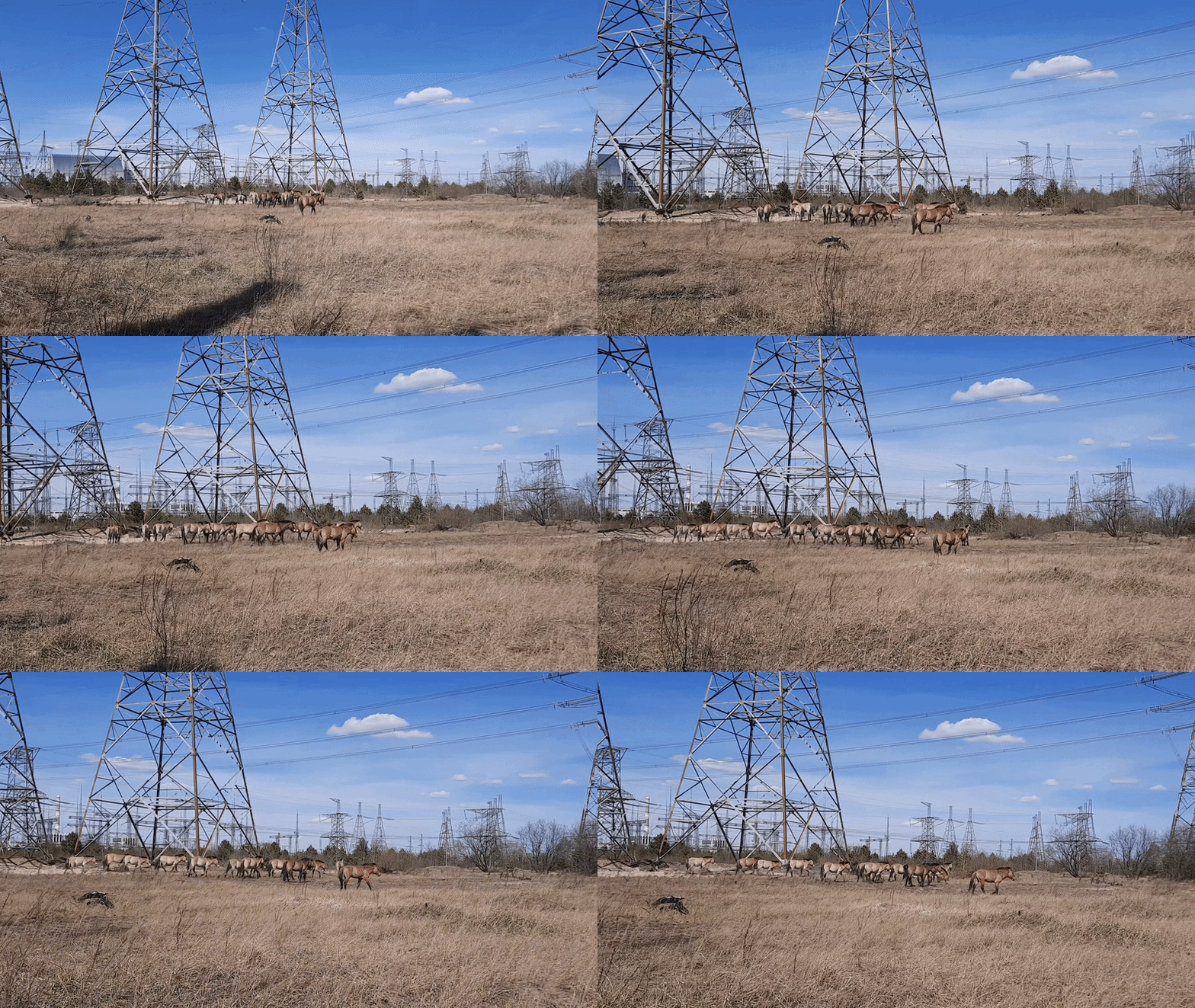
"Przewalski's horses have been reintroduced," says Andreas Zedrosser.
"Large predators had either disappeared or survived only in very small populations, but they have since recovered."
Kateryna Korepanova
"A number of smaller species have also moved into the area," Zedrosser adds.
Kateryna Korepanova
Today, wolves, foxes, lynx, wild boar, moose, European bison, and raccoon dogs are among the species that inhabit Chornobyl.
Kateryna Korepanova
Biodiversity has flourished in the exclusion zone since the disaster, according to Zedrosser.
"Chornobyl is a remarkable example of how resilient nature can be when it's simply allowed to recover."
Images from before, during, and after the occupation
The wildlife cameras in Chornobyl had also been collecting images during the year before the occupation, in 2021.
"That meant we had data from before, during, and after the occupation, as well as from nearly the same period the year before," says Richard Bischof.
He is a professor at the Norwegian University of Life Sciences (NMBU) and an expert in wildlife camera research.
"The cameras let us catch a glimpse into the lives of animal species in their natural habitat. They provide documentation that a species was present at a specific location. We can often see what the animals are doing in the images. Every photo is time-stamped, so we know not only where the animals were, but also what time of day they were recorded," Bischof explains.
The researchers investigated whether the animals' behaviour changed during the occupation.
To do this, they created a scale showing how intense the conflict was each day during the occupation of Chornobyl. They conducted interviews and monitored military activity. They used satellite data from NASA that showed changes in temperature caused by fires and explosions.
"It was winter and too early for natural forest fires in the area. That meant the fires were caused by human activity," says Svitlana Kudrenko.
This allowed the researchers to examine the animals' responses in relation to the intensity of the conflict.
Photo of wild boars in Chornobyl taken with a camera trap.(Photo: Svitlana Kudrenko)
Shifts in daily activity
One of the effects the researchers observed was that some species reduced their nighttime activity when the fighting was intense.
Some species became slightly more active during the day. These were species that are normally active at night under normal conditions.
Bischof notes that this is one of the most striking observations. He finds it somewhat surprising.
Not all species responded in the same way.
Annonse
“Roe deer became less active as military activity increased,” says Kudrenko.
The fewest roe deer were observed the day after the Russians withdrew. Kudrenko found this interesting. It was probably linked to Ukrainian forces moving through the area to secure it.
Roe deer became less active as military activity increased, according to the study.(Photo: Kateryna Korepanova)
One of the species that reacted quite strongly during the occupation was red deer.
“Red deer are normally more active at night. With the military activity, they may have become more restless and therefore more active during the day. The same applies to foxes,” says Zedrosser.
But the pattern was more nuanced. On the days with the most fires and explosions, the red deer became more active at night again.
Hares were also observed more frequently when there were nighttime fires.
"Were the results what you had expected?"
“We had expected that all activity would decrease. But the red deer, for example, did not respond that way. It seems that different species have somewhat different strategies for coping with this type of stress,” says Zedrosser. "But it's obvious that they did react."
The landscape has changed completely
Kudrenko hopes it will be possible to continue research on wild animals in Chornobyl. But she says it's difficult to obtain funding.
“It's quite risky to conduct fieldwork in Chornobyl right now,” she says.
She returned there last year.
“It has become a military landscape because of the border with Belarus to the north, so it's completely different from before the war,” she explains.
The researchers are not aware of data on how the war is affecting wild animals in other parts of Ukraine. But Kudrenko says the war is likely having a major impact on both wildlife and nature.
“Yes, of course. First and foremost, animals are being killed, especially in southern Ukraine along the coast, eastern Ukraine, and northern Ukraine near the borders with Russia and Belarus because of military activity. Many areas are also contaminated with landmines,” she says.
Inside the cooling tower of the former nuclear power plant.(Photo: Kateryna Korepanova)
War can have varying effects
What does previous research say about the effects of war on a country's wildlife?
"In a way, it's intuitive that direct acts of war disrupt animal behaviour," says Richard Bischof.
However, previous studies have generally been conducted during military exercises, not during actual warfare.
In general, war and conflict can affect wild animals. Not always in negative ways.
Bischof says there are two sides to the issue. During war, animals may be disturbed more by people, machinery, and military activity. In other areas, there may be fewer people because of prolonged conflict.
He points to the disputed areas between India and Pakistan, and the demilitarised zone between North Korea and South Korea. Along the border between North and South Korea is a heavily guarded zone. It is also littered with landmines.
Rare animals live undisturbed – in the middle of the conflict
"On both sides there are cannons aimed at each other, while in the middle there is a buffer zone that's completely unused. It has become a biodiversity hotspot," says Andreas Zedrosser.
More than 6,000 plant and animal species have been documented between North and South Korea. Endangered species such as the Siberian musk deer, the red-crowned crane, and the Asian black bear live there. Possibly even the extremely rare Siberian tiger.
In more local and regional conflicts, the effects can also go in the opposite direction. Conflict can lead to increased poverty and more hunting of wild animals. Zedrosser points out that this has been observed in, for example, Africa.
"Hunting pressure increases because people need food. Animals that are worth a lot of money, such as elephants or rhinos, may be exploited by warlords as a source of income," he says.