Spring is approaching, and suddenly you might notice tiny black insects buzzing around your living room. It's easy to assume that they're fruit flies.
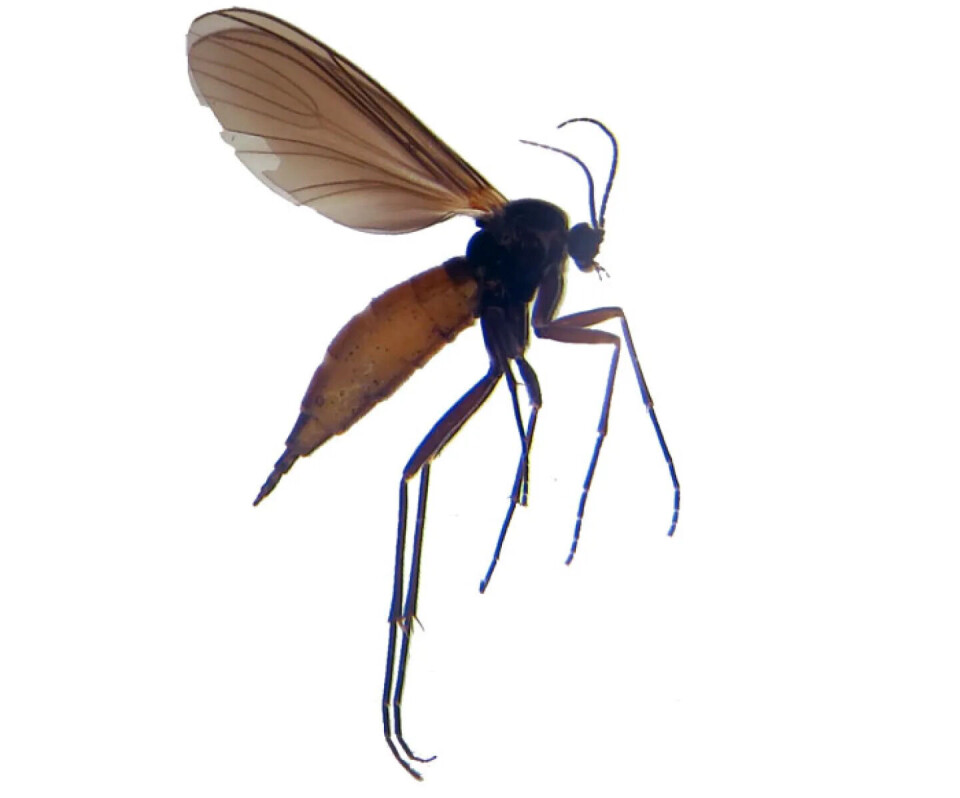
But these insects are much more slender, and they are not interested in food and sweet things.
They are fungus gnats, and they live in your potted plants.
They lay eggs in your plant pots
Most of these small gnats normally live outdoors in nature. They belong to a large family of gnats, with several hundred different species found across Europe.
Annonse
"You see them flying around in forests, but only a few species come indoors," says Geir Søli.
He is an expert on fungus gnats and works as a researcher at the Natural History Museum in Oslo.
Fungus gnats can fly in through your window and settle in your plant pots, where they lay their eggs.
Geir Søli studies fungus gnats. He sees them everywhere, especially on shelves with herb plants in stores.(Photo: Nina Kristiansen / Science Norway)
"But they're often in the soil of the plants you buy. I see them all the time, especially on basil and other herb plants from the store," says Søli.
Science Norway visited three flower shops that had either not heard about fungus gnats or did not want to discuss them. It's possible that the insects spread through the plants they sell.
No, it's not a fly
Marianne Hauge at Jord, a shop that sells flowers in Oslo, knows exactly what this insect is, even though customers often call them hoverflies. But that label is incorrect both in terms of their size and their insect group.
The fungus gnat is between two and four millimetres long. You may find it near a plant or on a windowsill, although they also fly around inside your home.(Photo: Norwegian Biodiversity Information Center)
Once the fungus gnat reaches adulthood, its life is almost over.(Photo: vuk / CC BY 4.0)
Adult gnats live for only about a week, but during that time they typically manage to lay around 100 eggs, according to NIBIO's plant protection encyclopedia. These develop into larvae that are almost impossible to see.
The larvae feed on plant remains in the soil and on the fungal cells that break them down. It takes them more than 20 days to develop into adult gnats.
"The larvae thrive best in moist soil. The more nutrient-rich the soil is, the more food the larvae have available," says Søli.
Can kill the plant
A few fungus gnats in your home will not harm your plants. But if there are many of them, they can affect the plant's health.
"When there is little fungus in the soil, they start feeding on the smallest and thinnest roots, which are very important for the plant's ability to absorb nutrients. If fungus gnats are present in large numbers for a long time, the plant may weaken and eventually die," says Søli.
He is careful to keep newly purchased herbs separated from the other plants in his home to prevent fungus gnats from spreading and laying eggs there.
Annonse
"If the plant is wrapped in plastic in the store, you can check whether you see gnats before buying it," says Søli.
Do not like dry conditions
The easiest way to deal with fungus gnats is to keep the soil dry, which kills the larvae.
This is the advice Marianne Hauge gives to customers who find the small insects unpleasant.
Marianne Hauge runs the shop Jord in Oslo. She says fungus gnats are not a problem there.(Photo: Nina Kristiansen / Science Norway)
"When we water plants, water can easily collect at the bottom of the pots. Insects like that. Let the plants dry out between waterings, as long as they are plants that tolerate some dryness," says Hauge.
If that is not enough, she recommends covering the surface of the soil in the pot with vermiculite, a mineral material often used when sowing seeds.
It's also possible to buy sticky traps that catch the gnats.
In her own shop, Hauge says she has few problems with fungus gnats.
"I sometimes see them in the shop, flying up when I touch the plants. But they quickly disappear on their own because I keep the pots dry enough. It takes quite a lot of them before they become a real problem," she says.