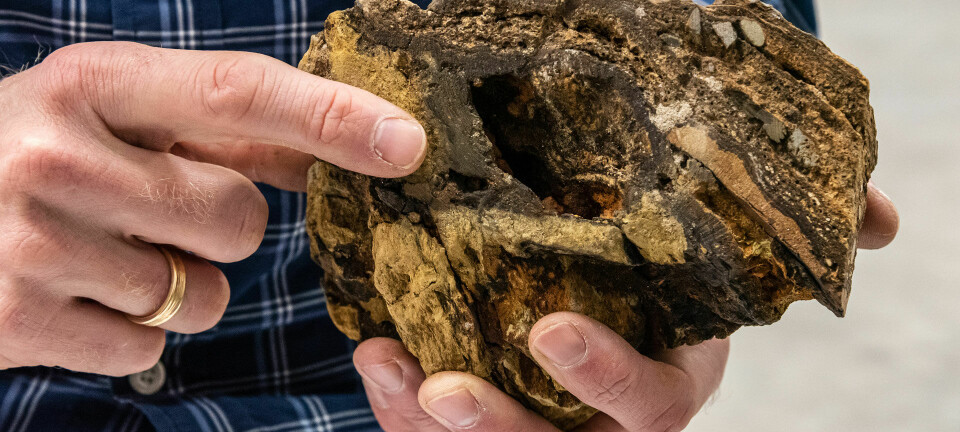
"Still, the situation is more complicated than simply locating and extracting minerals," Ståle Angen Rye tells Science Norway.
He is a professor of human geography at NTNU.
Building a European value chain
"The EU wants to achieve what's called strategic autonomy, which is about securing the value chain," says Rye.
Ståle Angen Rye researches public engagement related to mineral development and sustainable transition.(Photo: NTNU)
He explains that the value chain for such minerals stretches all the way from exploration to recycling. Securing the chain within Europe would mean carrying out every step on European soil.
"This requires reliable access to raw materials, preferably from your own territory. And once we have materials on Norwegian and European soil, we must keep them here," says Rye. "That requires a comprehensive strategy, and China has had that for several years."
At the Fens Complex, they are still at the very beginning of the value chain, in the exploration and development phase.
China's advantage
"Reducing dependence on China is a central motivation," says Gørild Heggelund, a senior researcher at the Fridtjof Nansen Institute.
She studies China's environmental, energy, and climate policies, and sees clear difficulties with the current situation.
"The challenge is that extraction, production, and processing are concentrated in a small group of countries, including China. That creates a significant supply risk if something were to happen. The geopolitical situation we are in now means that Europe and Norway want to become less dependent on China," explains Heggelund.
Last year, China tightened its control over rare earth elements, according to CNBC.
Because China dominates such a large share of the global market, it has the power to restrict access to these materials, potentially making it harder for other countries to produce defence equipment.
Annonse
"Last year, China introduced export controls on some minerals and that could affect the security aspect for us in Europe. The Fen Complex could become important for Europe because it could provide secure access to technology for green industry and defence," explains Heggelund.
Both Rye and Heggelund emphasise that China currently holds a strong advantage in both industrial capacity and political strategy.
Gørild Heggelund is a senior researcher at the Fridtjof Nansen Institute.(Photo: FNI)
"China has pursued long-term policies on the extraction of critical minerals and earth elements. Already in the 1990s, China's leader Deng Xiaoping said that 'the Middle East has oil, China has rare earths'," says Heggelund.
New challenges
As things stand today, both Norway and the rest of Europe lag far behind China.
"You have to extract, process, produce, and recycle. The technology to do this has to come from somewhere. It could easily come from countries such as China, and the financing could also possibly come from there," explains Rye.
He says this is a new challenge in the West. Previously, Western countries relied on global value chains being predictable and at the same time had greater control over global markets.
"As the global balance of power shifts and supply chains become harder to control, this model may no longer benefit us in the same way as before. This becomes even more complicated if we can no longer rely on the United States," he says.
But the researchers also point to a dilemma in trying to move the entire supply chain to Europe.
"Climate and energy transition are still on the agenda in many countries, and that creates a dilemma. We need Chinese technology for solar power, wind power, and electric cars, but if we are going to produce all these things ourselves it becomes more expensive and takes longer," says Heggelund.
"Then the question becomes: 'Why should we produce rare earth elements at the Fen Complex if it can be done much cheaper in China or Brazil?'," says Rye.
Local considerations
The Fen Complex is located in Nome municipality, which has about 6,500 residents and faces economic challenges. In 2025, the municipality was close to ending up on Norway's ROBEK list.
Mining projects are often associated with local opposition. There can, for example, be dissatisfaction related to the disposal of mining waste, as seen in the case of mines at Repparfjorden in Hammerfest.
"Investments of this kind almost always involve conflict. That cannot be avoided. Then you have to assess how much the costs of mining can be reduced and whether the yield is worth it or not," says Rye.
However, the situation in Nome appears to be somewhat different.
"There seems to be little opposition to this in Nome. Industry and mining created the village, and mining is something the local community may be accustomed to," explains Rye.
Can it work?
"Could this discovery be the start of European independence in the mineral sector?"
"It could be, but this is not a quick-fix. If you manage to achieve strong local support, gain social acceptance, and have good political processes at the local level, together with a well-thought-out strategy nationally and from the EU, then it might be possible. But it's not simple, in that sense," says Rye.
"In the short term it will be very challenging for Western countries and Europe to become completely independent of China. But if materials can be extracted from the Fen Complex, it might make a meaningful contribution towards reducing that dependence," says Heggelund.